

Everything I read in June
On planning not to read, off-season reading and really, REALLY, really good Substack writing advice.

About twenty years ago I stole my friend’s copy of Hayden Herrerra’s biography of Frida Kahlo and boarded a flight from Munich to Philadelphia. I opened the book as soon as I buckled my seatbelt and did not look up for ten hours straight. That reading experience is one of the highlights of my life as a reader and I have been chasing that high ever since. The only time I have come close to experiencing that same feeling of complete absorption and exhilaration was this past January. I began reading The Last Samurai as we boarded a flight from Memphis to Santo Domingo and finished it, breathless and trembling, as we were landing back in Memphis a week later. 10/10 recommend.
When I started packing for our summer trip to Europe earlier this month, I spent a significant amount of time trying to figure out what to bring. I considered giving Middlemarch another try after starting and abandoning it last summer. I considered bringing War and Peace (lol). But in the end, I decided to bring The Collected Stories of Lydia Davis, Malina by Ingeborg Bachmann and Missing out - In Praise of the Unlived Life by Adam Phillips. I am a massive Lydia Davis fan and was really hoping to have an intense, immersive experience with her work. Plus, I knew that she could be both poignant AND insanely funny, which I thought would be great for a summer read. Malina, in turn, has been on my list for a while but aggressively so since the book bubbled up in my Checkout 19 syllabus AND I learned that Bachmann was one of Fleur Jaeggy’s closest friends. Finally, I really wanted to read that particular Adam Phillips title because I had been feeling painfully homesick and nostalgic and I suspected that he would say things that I needed to hear.
Well… that was the plan. And here’s how it went:
I read a significant portion of the Lydia Davis collection but after a while, I noticed that I was losing interest and was unable to read for long stretches of time. Part of it was the fact that I was reading short stories, I think, which felt very stop and go but after a while, I felt that the stories themselves were starting to feel a little monotonous and repetitive. While my husband and my kid were splashing in the water at Seixal’s famous black sand beach, I decided to set the book aside and rest my eyes for a moment…
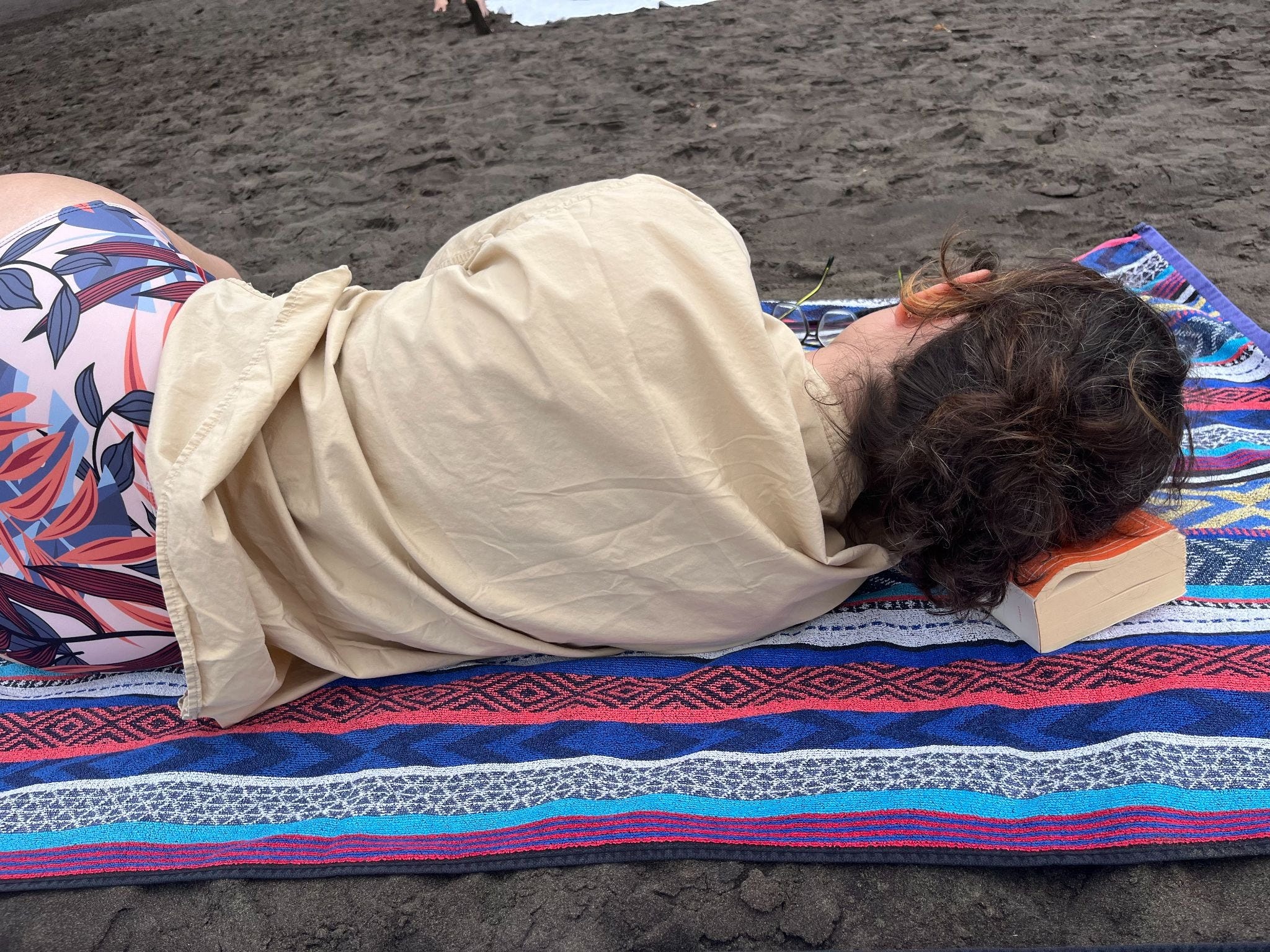
The book was a great beach pillow but I decided that using it that way was probably my sign to set it aside for a bit and return to it at a more opportune time.
I moved on to Malina. I felt HYPED to read it… but had I done a little bit more research on it, I would probably not have brought it with me… not because I don’t like it but because I really do. The book is a THINKER and is written from a super claustrophobic, almost solipsistic point of view. I love nothing more than a novel about the fragmented consciousness of a complicated woman but, frankly, it was not the kind of thing I could read sitting next to my kid while someone was handing us pretzels.
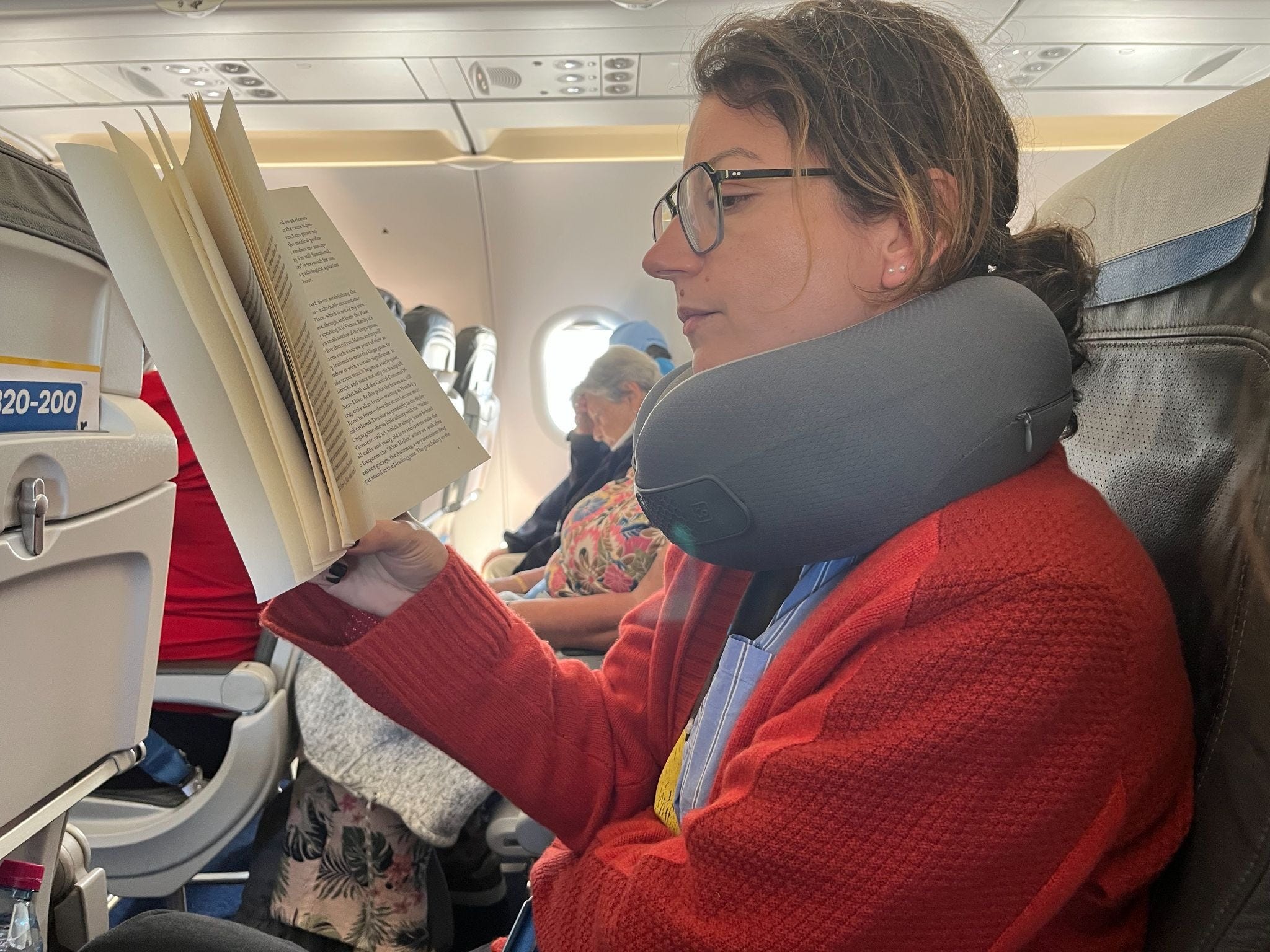
Mildly disappointed, I thought that maybe once we left Madeira and made it to Bulgaria, I would settle in and read my thematically appropriate psychoanalytic book. But once we made it home, I felt such a profound sense of love and belonging… more so than I have ever felt in the 27 years since I first left… that I just could not make myself even pick up the book. This is not an immigration-focused Substack but maybe one day I will share more about the roller-coaster that has been my experience and maybe you guys can help me make sense of it.
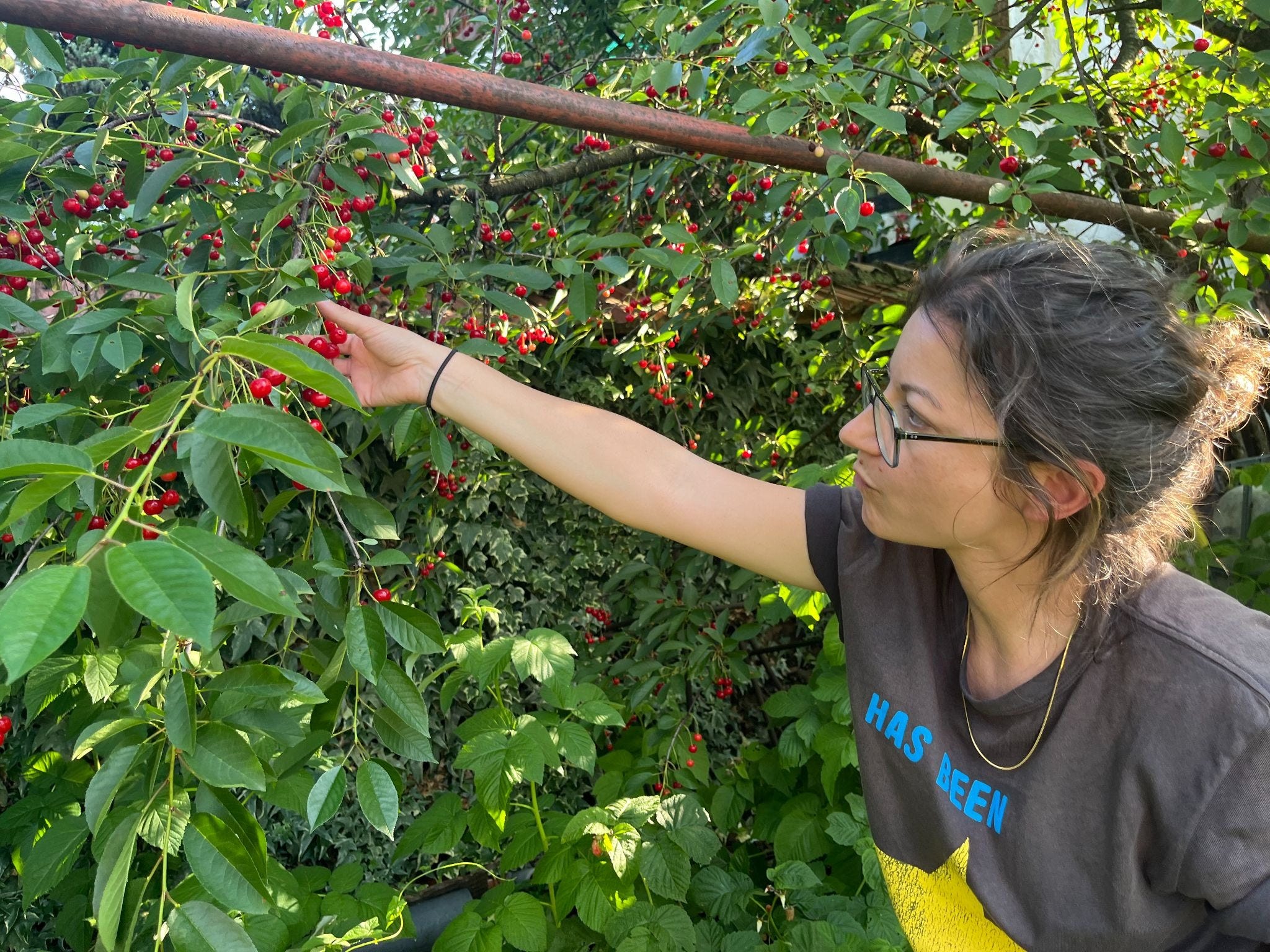
My parents are getting older and I am finally finding myself able to let go of any impatience or resentment I may have carried in the past. Watching them work so hard on building meaningful, loving relationships with my kid and my nephew felt honestly so healing and beautiful. I really felt grateful for being able to stay in the moment and notice how much love there was between all of us there.

Those of you who’ve been reading me for a while know that I have never been able to relax about a single thing in my life and are probably wondering why I am so lowkey about all the reading that I did not do while traveling. But careful readers will remember from when I shared my planning method earlier in the year that I actually plan for busy seasons and slow reading periods. I know that many people find summer to be the most fertile ground for catching up and doing massive amounts of reading. For me (and probably most working parents in America)... summers are a shitshow of logistics and broken routines. I used to hate it but now I plan for it and what I truly mean by that is that I lower my expectations and then lower them some more. I am basically focusing on keeping my kid safe, cared for and appropriately stimulated and in whatever free time I have from work, I just choose to throw on my old swimsuit and hustle everyone to the community pool so that we can experience summer as a family even if we need to do so in the most American way with our ridiculously small vacation allotments. In my experience, PLANNING NOT TO READ is painful and disappointing but not as disappointing as planning to read but not being able to do so. It is important for me to make an effort to fit reading into every available nook and cranny of my life but I also do not want to fight my life at every turn. Acceptance is such a beautiful feeling.
All that being said, I had a great reading month.
📚 Books mentioned:
Show Your Work — Austin Kleon (re-read)
Keep Going — Austin Kleon (re-read)
Don’t Call It Art — Austin Kleon
The Things We Never Say — Elizabeth Strout
A Sense of Occasion — Brodie Crellin

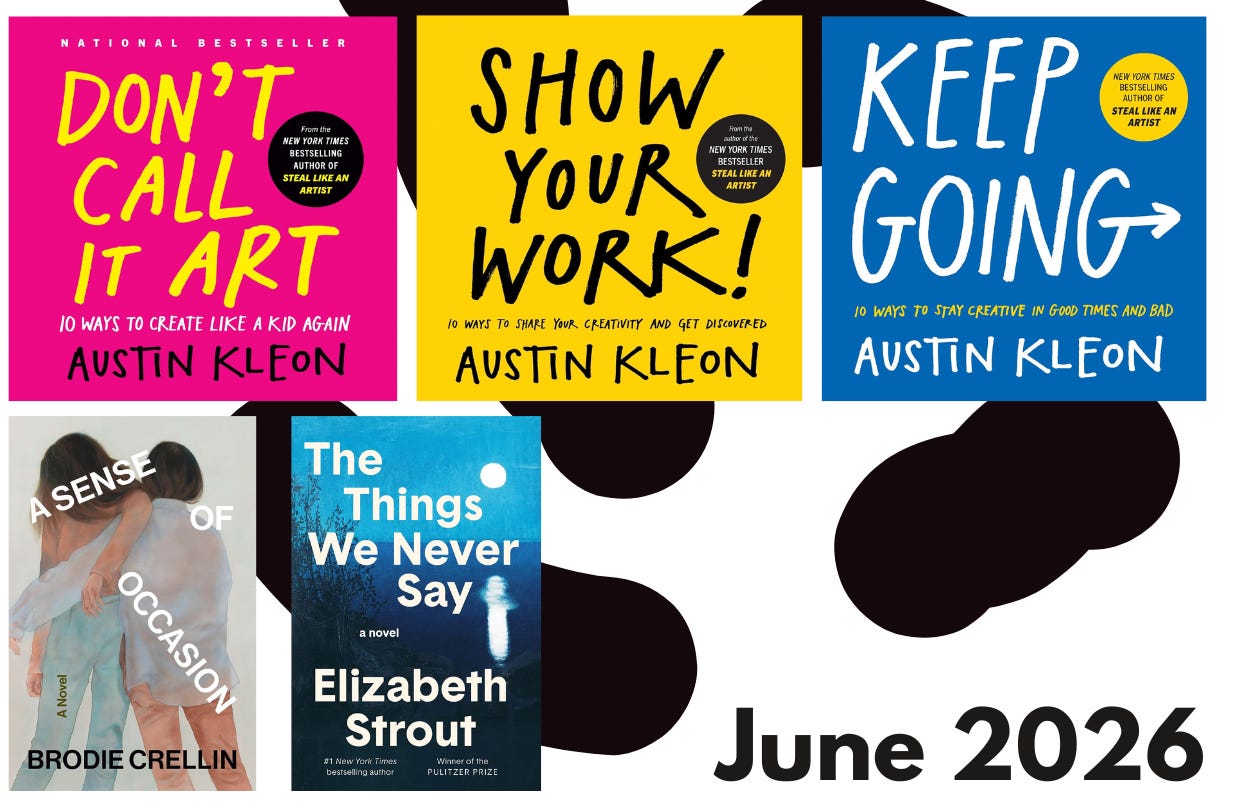
📚 Show Your Work | Keep Going | Don’t Call It Art — Austin Kleon
Before we left for vacation, I re-read Austin Kleon’s Show Your Work and Keep Going in preparation for his Reading Life interview (which brought so many of you here! WELCOME, WELCOME!!! I know that you are my people). I also read his new book — Don’t Call It Art — which felt both familiar in tone but new and additive in message. As I mentioned in my introduction to the interview, I have been a massive fan of Austin’s work for years but intuitively so. However, as I was reading him this time… I couldn’t help but notice how incredibly insightful his advice felt in the context of newsletter writing and from now on I will be recommending these books to anyone who is wondering if they should start a newsletter — You don’t have to be a genius! — or if they have the time — Share something small! Teach what you already know! — or if they are good enough to deserve an audience — You have permission to be bad! — or if they need a growth strategy — Forget the noun, do the verb… You don’t need a vision!
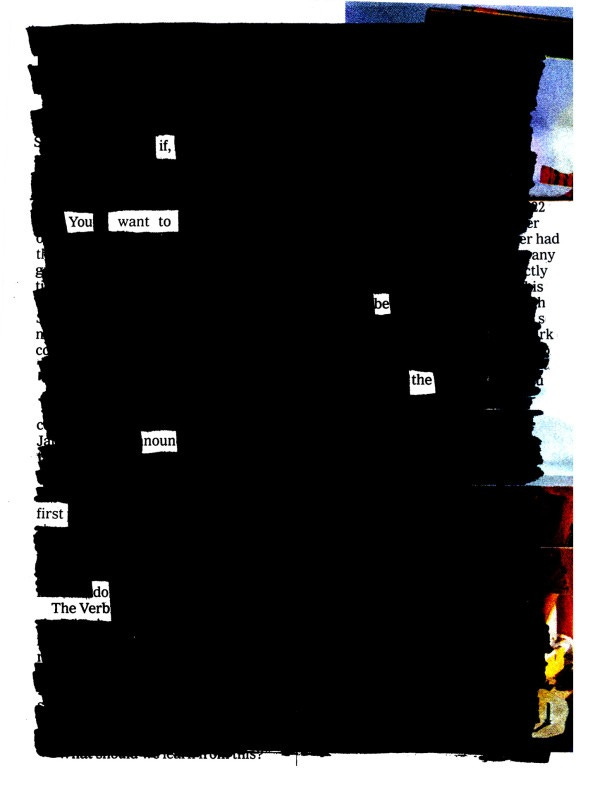
Austin is not only an incredible artist and a good human, but also a real reader. I can’t imagine why you would not be familiar with his work already but if you are not, I am so happy to be the person who introduced you to him.
📚 The Things We Never Say — Elizabeth Strout
I also read Elizabeth Strout’s latest novel, The Things We Never Say. It follows Artie Dam, a 57-year-old high school history teacher on the Massachusetts coast. By all appearances, he’s content: well-liked by his students, married thirty years, out on his sailboat most weekends. But Artie is secretly contemplating ending his life. A decade-old wound sits at the center of it — his son Rob survived a car crash that killed his girlfriend, and has stayed withdrawn ever since. An unspoken distance from his wife, Evie, only deepens Artie’s isolation. Then a chance incident cracks that isolation open, forcing him to confront a secret his own life has been keeping from him, and to reckon with how little we ever really know the people closest to us.
I really enjoyed this one. Earlier this year I set out to discover my off-season genre, and after a failed attempt at romance appreciation, I took my friend Kate Jones’s advice and gave Strout a try. Like everyone else in the world, I have fond memories of Olive Kitteridge, so it seemed like sound advice. I didn’t love this particular book, but it was a shot in the right direction. Strout’s writing is gentle, kind, truthful, poignant — and there’s so much of it. That’s how Strout herself described her love for William Trevor’s work, when Pandora Sykes asked who she turns to for clarity, comfort, and wisdom. I think her answer explains exactly why so many readers around the world are drawn to hers. If you have read more Strout than me, do share what I should read next!
📚 A Sense of Occasion — Brodie Crellin
Finally, I just completed A Sense of Occasion by Brodie Crellin, which I started reading on a Saturday morning in my own bed, in my own clean sheets, propped against my own reading pillow, with a cup of coffee in hand. Between the relief of finally being home after two weeks of travel, the ideal reading setting, and a book that was both thematically and stylistically fun to read… I felt so happy in this book, I thought I would cry.
It’s a queer mix of Meg Mason’s Sorrow and Bliss and an Elizabeth Strout-like universe of characters who are touching in how bad they are at concealing their loneliness.
When Mary — an odd-ball art teacher — dies suddenly, her family converges on her small house in an English village to organize the funeral. Patch, her daughter, is aimless in life, working a deadend job and muddling through her dating life, entering messy situationships with her cousin’s ex. Robin, Mary’s ex — an English-teacher-slash-actor eleven years her junior — shows up to support his daughter but also makes time to visit the local lay-by where he used to meet farmers for sex. And Jude, Patch’s estranged cousin, drives in from Naples — funded, like everything else in her life, by upper-crust parents. Jude scores high in executive function but is equally lost. It takes a while to figure out if she is legitimately affected by her aunt’s passing or if she is looking for an opportunity to act superior to her estranged cousin.
Thrown together over a sweltering funeral weekend, old resentments and desires keep surfacing, pulling their fragile reconciliation apart. Running underneath it all is a queer current — the part of the book that I enjoyed the most — Robin’s cruising is just the most visible example of an entire family whose sexual selves rarely match the ones they present to each other and the world.
Like Strout, Crellin is extremely skillful at pushing the story forward while moving between past and present without info-dumping. The novel does this formally, shifting among Mary’s, Robin’s, Jude’s, and Patch’s points of view and letting flashbacks fill in the history only as each scene needs it, rather than front-loading it.
I really loved the older characters’ plotlines — Mary and Robin, the singularity of their personalities, the oddity and authenticity of their relationship, how alive and trapped by class and circumstance they felt — and found the younger generation’s characters, Patch and Jude, so incredibly annoying and entitled by comparison. I haven’t decided yet whether that’s the book’s asymmetry or mine. Funny and charming without trying too hard, the book is a great story of how class, gender and sexuality have a million different ways of interweaving and defining the contours of one’s life. I really liked it.

The PLANNER Community1 likes to talk about the elusive concept of PLANNER PEACE — the idea that if you put in an effort, you WILL be able to find the perfect notebook or system that will fit your needs, your taste and your brain… so much so that you will never want to change it. As you can imagine, many have heard of the concept but few have lived it. I have not experienced PLANNER PEACE but this month I felt like I experienced READER PEACE. I had this strong sense of KNOWING and ACCEPTING what, how, when and why I read and I felt very much at peace with that. I am trying to hold on to that feeling because I know it’s fleeting.
❤️ Favorite books of 2026 so far:
January — Autobiography of Red — Anne Carson
February — The Copenhagen Trilogy — Tove Ditlevsen
March — Repetition — Vigdis Hjorth
April — Loved and Missed — Susie Boyt
May — Painting Writing Texting — Chantal Joffe and Olivia Laing
June — Show Your Work | Keep Going | Don’t Call It Art — Austin Kleon
I hope you are having an amazing summer and that, above all else, you are at peace with your reading.
🤓 As always, I have some questions for you:
Do you read more or less while traveling?
What is your ULTIMATE reader experience that you try to replicate?
What does READER PEACE look like for you?
The Planner Community == community of people who are passionate about paper planners and methodologies.
Elizabeth Strout… I loved and still love Amy and Isabelle, My Name is Lucy Barton, The Burgess Boys, Olive Again. Anything is Possible. Oh William. All except Lucy by the Sea and Tell Me Everything. I still don’t understand what happened there.
Oh, I have my travel/vacation books picked out before the tickets are purchased!!