

Vernacular reading
Or…what I think about when I write about reading

Pre-script: Through the end of February, I am offering 45% off annual subscriptions. Thank you for reading and always making me feel so seen and understood. ❤️
I delayed this post by a day so I could tell you — I am 45 today and I am thinking a lot about getting older. There is a lot to say about that, especially five days into starting HRT, which feels both boring and dramatic. But beyond all of that, what stands out to me is how much freer I feel. Getting older has made me realize that most of what we fear is far less catastrophic than we make it out to be. When you realize that yes, there may be a cat there — but at least the cat is not a tiger — suddenly there is peace.
I bring up aging in the context of this newsletter because writing here and talking books with you guys has become one of the areas in my life that allows me most vividly not only to explore what it means to be an aging, changing human, but to practice what I learn. And that’s different from why I started. I’ve written before about what pushed me into this space — burnout, early motherhood, post-partum depletion, the feeling that my interior life had somehow thinned out. But lately I’ve been thinking less about what made me begin and more about what keeps me here.
The reading, the writing, and the conversations have filled an important social gap I didn’t quite know was there. I am fully aware that I could still be reading on my own without running my mouth about it publicly. And yet I don’t.

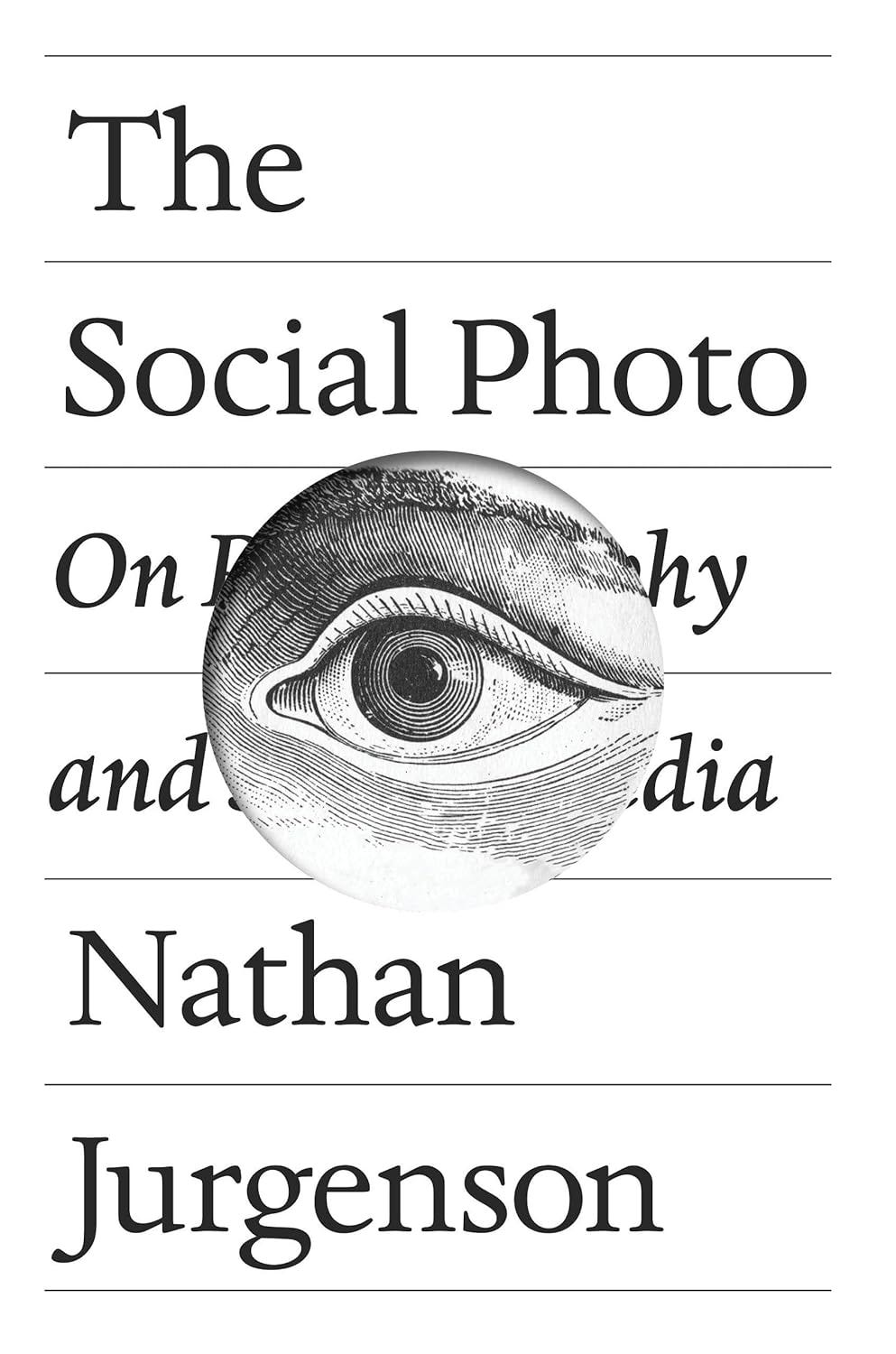
I’ve been reading nathan jurgenson’s The Social Photo: On photography and social media, which challenges the assumption that social media photography is simply a degraded or amateur form of traditional photographic art. His argument is not that the images we post are secretly masterpieces, but that we misunderstand them when we evaluate them primarily as aesthetic objects. Social photography / Networked Images / Vernacular photography operates according to a different logic. Its primary function is communicative rather than compositional. It exists less to endure as art and more to circulate as exchange — to mark presence, to situate the self within a network, to register “I was here” in relation to others. The social image is embedded in ongoing interaction; its meaning is inseparable from the social field in which it moves. Understood this way, vernacular photography is not a lesser category of art but a distinct cultural practice, shaped by relationality, temporality, and participation.
The more I think about this reframe — from object to practice, from artifact to exchange — the more I recognize something similar in the way many of us read and write about books online. Just as most people sharing photos they took with their iPhones don’t necessarily think of themselves as photographers (even though some absolutely do), many of us who share our thoughts about books do not necessarily think of ourselves as critics. That doesn’t mean we are unserious. It means we are engaging in a different practice.
For me, reading is first and foremost an aesthetic experience. I love being immersed in a text for its own sake. I love sentences that break skin. I love the pleasure of appreciating something on its own terms without asking it to be useful beyond the hours I spend inside it. But that is only part of the experience I’m actually living. A big part of the pleasure of reading for me — especially now, in this stage of my life — comes from the sharing. From writing about what I read. From watching how our conversation unfolds in the comments. From the DMs. From the Friday chats. From the small shocks of recognition when someone says, Yes. That. I felt that too.

Tell me if I’m wrong, but I think one of the reasons this community — and I don’t just mean HERE-here, but more broadly book-Substack — has become important to many of us is not simply because we share similar tastes (although in many cases we do). It’s because reading functions as a vehicle of self-articulation. The books we gravitate toward reveal our affinities and our longings; they help us assemble a self that often feels more precise than the roles we inhabit at work or at home. Reading becomes a declaration: this is the intellectual lineage I want to stand in; this is the kind of mind I want to call mine.
I’ve lived through enough iterations of internet culture to know how quickly online communities can turn brittle or performative or exhausting. And yet — I don’t know how else to say this, I know it’s corny — I have never felt more happy or proud to be part of an online community than I do right now.
Our people here are so fucking great. The tone here feels different. It is slower. Less interested in annihilation. We disagree sometimes, but we rarely try to destroy, and it feels to me like there is room for thinking out loud. I don’t take any of that lightly.

In The Social Photo, Jurgenson writes that snowstorms produce a blizzard of images — an extra inch of snow as evidence of time passing. Or, as Svetlana Boym explains, the experience generates anticipatory nostalgia for the present moment that flees with the speed of a click. Documenting a reading life works in a similar way. A well-groomed Goodreads account is the literary equivalent of a blizzard photograph — a small, repeatable gesture that marks time as it accumulates.
Because the thing people say about getting older and time flying is absolutely true. You think of something that feels like it happened centuries ago, but when you remember what you were reading at that time, the memory sharpens. You can almost always connect a book to the life that was happening around it: who you were arguing with, what you were afraid of, what you were longing for. In that sense, the living becomes one with the reading, and the reading becomes the memory of the life.
Maybe that sounds depressing to some of you, the idea that books can become our timelines… but to me it feels beautiful. It means I wasn’t just drifting. I was thinking. I was paying attention. That is what vernacular reading really is for me now: reading practiced as aesthetic encounter AND shared attention.
🤓 Some questions for you:
Have your reading goals changed this year?
What’s one thing you’re proud of in your reading life right now?
Want to share a Concept Project you’re thinking about for the rest of 2025?
Happy birthday! Forty-five, eh? Where was I then and, more to the point, what was I reading? Hmmmm. Ah, I was in the same house I'm in now and working a job I hated, but reading just as much as I do now. It's my constant, my love, my escape. And right now, at 54, it's better than ever! And that, my dear friend, is largely down to the online book space. I didn't know back then that I could write about books and make videos about books and lead others through books. Since leaving uni in 1998 and joining the big bad world, I'd been reading pretty much alone, with no one to talk to about what I was reading or to listen to about what they were reading. And now, look at us go!
Have a great day!
Petya, happy birthday! Everything you spoke of resonates with me. I am a few years older but not much so we are in a similar stage of life where time and aging take on a new focus. This space and broader community have been good for my soul. It has allowed me to grow, to feel, and to change.
This year I see my reading shifting. I have a couple of projects I am reading for. One here on Substack, the other a personal learning project. Beyond that I am allowing myself to read for joy. For the last few years I got into a routine that almost became performative. Oh, I have to read this prize winner or that best seller because everyone is talking about it. There can be value in that at times but this past week I crowd-sourced ideas for a genre I love and it was amazing! So many great recommendations in genre fiction and it made me happy to have a community who enjoys those same things.
I am continually on the lookout for fresh voices. I believe reading the classics and the critical works of literature is important. But I also need new and unheard voices. Voices in translation. Voices that are just a whisper at the moment but l seeking an ear. Voices that make me think and rethink who I am.
Love you my friend. Keep writing and inspiring and growing and reading!