

Everything I read in May
Featuring artistic devotion, dystopian longing, difficult mothers, and Anne Carson in the frozen north

A quick note for our friends who are new here: every month I write a post about everything I read. Sometimes the books cohere thematically and I am able to talk to them as a group, other times the only thing connecting them is that they all happened to land in the same thirty days. But I love the discipline of it. Knowing I’ll have to share this update keeps me reading and, more importantly, keeps me paying attention
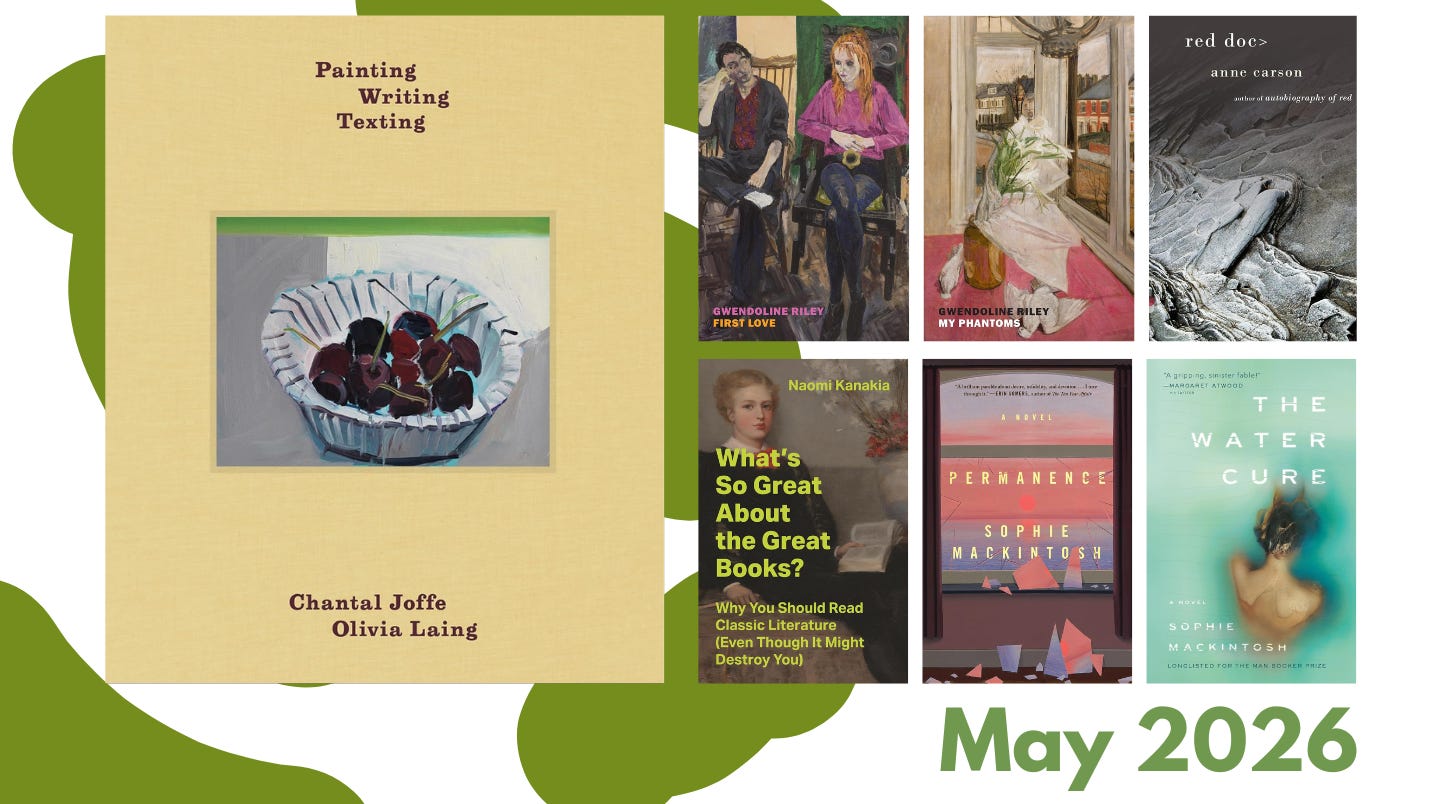
📚 Books mentioned:
What’s So Great About the Great Books — Naomi Kanakia
Painting Writing Texting — Chantal Joffe and Olivia Laing
Permanence — Sophie Mackintosh
The Water Cure — Sophie Mackintosh
First Love — Gwendoline Riley
My Phantoms — Gwendoline Riley
Red Doc> — Anne Carson

When I pick up a novel, I typically don’t move on to the next one until I am finished. With nonfiction — I take more notes, I need more time. I had a very interesting experience of spending a lot of the month with Naomi Kanakia’s new book — What’s so great about the great books? — and I thought it was the perfect backdrop to all the contemporary reading I was doing.
📚 What’s so great about the great books? — Naomi Kanakia
In her 20s, Naomi Kanakia started reading the Western canon because she wanted to be a better writer. She picked a list and went after it, reading as a lay person — the way she would approach any contemporary work of fiction — trusting that eventually it would all make sense. Spoiler alert: it did. In reading the great books, Naomi discovered a shortcut into the history of ideas and a record of how seriously humans have always taken the questions we think belong to us. The political despair, the moral confusion, the exhaustion with institutions — it's all there, and it's handled with style, rigor and integrity, even if the reading experience itself sometimes comes with "a bit of a health-food quality" to it.
I loved reading What’s So Great About the Great Books? partly because over the last couple of years I have been following the ADHD-brained version of this plan — intuitively picking up classic titles here and there, talking myself through the shame of getting to these titles so late in life (so late is not the same as too late1). Reading Naomi’s book had me revisit Ted Gioia’s Lifetime Reading Plan which I have referenced many times before. As much as it saddens me to admit it, I am not sure that I can ever commit to such a rigorous reading project, but perhaps the most disarming argument in Naomi’s book is the argument in favor of owning your curiosity, of being open to the potential of your own intellect and being unafraid of reading work that will challenge you stylistically, morally, philosophically. In fact that’s probably the best reason to be doing that reading in the first place.
📚 Painting Writing Texting — Chantal Joffe and Olivia Laing
Reading Naomi’s book was truly good for my soul as a reader as it created the mental space I needed in order to allow myself to learn and read in a direction that I have felt curious about for ages but kept self-centering. When I read Loved and Missed by Susie Boyt earlier this spring, I went looking for the NYRB cover art and discovered it was a Chantal Joffe painting, a painter I had a vague familiarity with but whose work I had not explored in earnest. I spent a great deal of time in May learning about Joffe’s work, which in turn led down the corridor of her friendship with writer and art critic Olivia Laing. Apparently, Chantal read The Lonely City, wrote Olivia a fan letter and invited them to sit for a portrait. Olivia accepted and thus began their friendship. Last year they made this incredible book — Painting Writing Texting — part paintings, part essay collection.
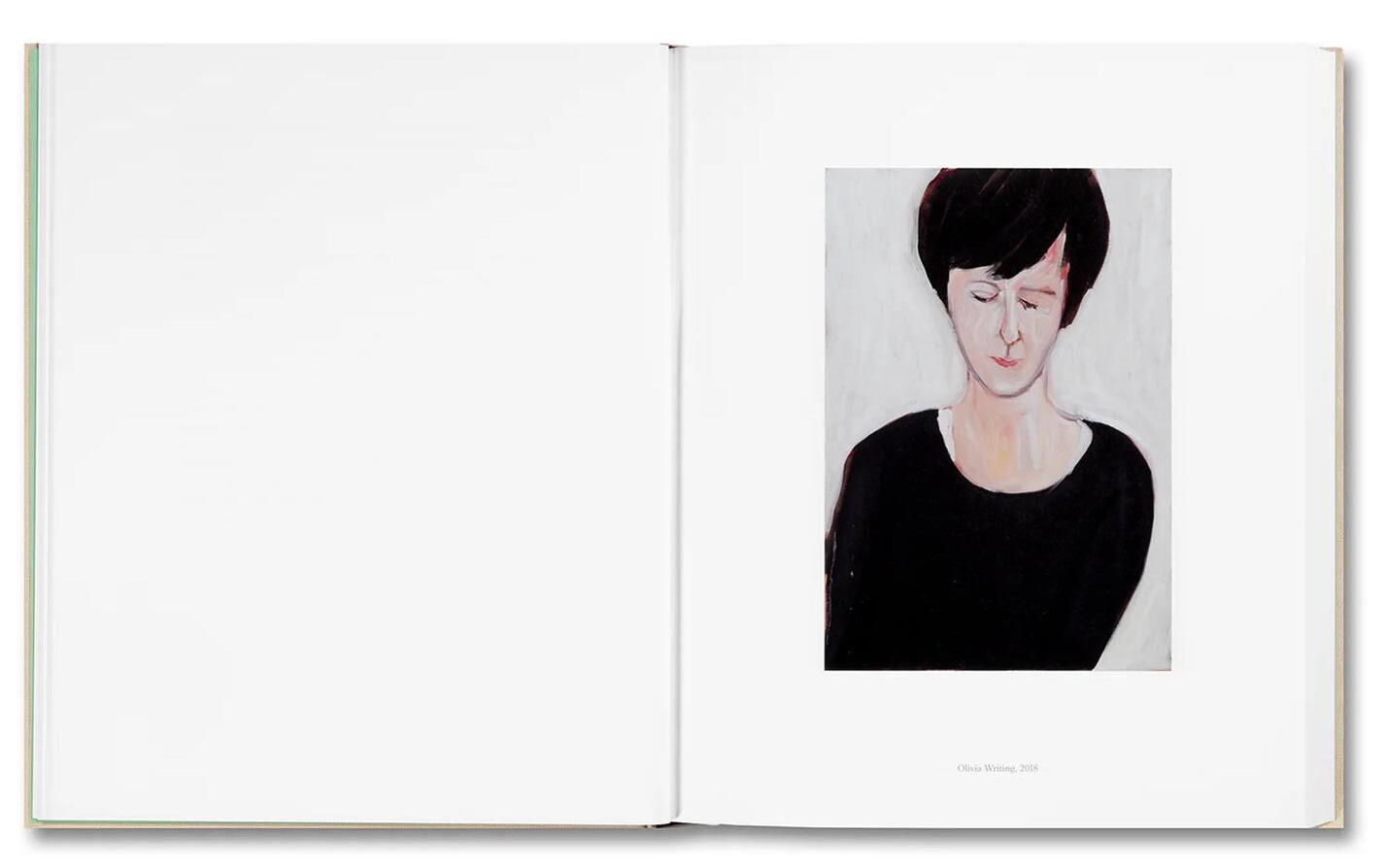
The book explores the idea of artistic practice and the specific relief of having someone in your life who understands what you make. There’s a section on their various trips to Venice and how they each respond to the same experience through completely different work. What the book is actually about, I think, is the question of whether friendship can be a form of creative metabolism, whether being known by the right person changes what you’re able to make… And, for me at least, that is an absolute fact.

I then read four novels in a row that were all, in different registers, asking what women actually want… as in… Who are we, actually? And what the fuck is the point of all this when those who are supposed to love and protect you are probably the ones who harm you the most? Why bother be a partner? Why bother be a daughter?
📚 Permanence — Sophie Mackintosh
I read Sophie Mackintosh’s Permanence after devouring this conversation with Elvia Wilk. The story follows Clara and Francis who begin a relationship after meeting in the most romantic way at an art museum, being hypnotized by the same painting. Too bad that Francis is also married and the father of a young child. We travel through the highs and lows of their affair when one day the two find each other able to be open and public about their relationship because they are now residents of a city in which everyone else around them is similarly removed from the real world and allowed to exist with no risk of punishment or shame with their lover. I was worried that I would find the premise of the novel gimmicky but found the dream-like quality of Mackintosh’s writing bewildering and fitting for the liminal world of love and betrayal she has built in Permanence. The book moves back and forth between the two worlds as we learn more about the nature of the relationship, about the level of love, commitment and sacrifice it demands from both of them and the mechanisms at work that make them move back and forth. Permanence brought me flashbacks of On the Calculation of Volume v.1 — which is not a book that I enjoyed — and I thought it handled similar questions around marriage and relationships with much less construction and artificiality while hitting similar disorienting notes.
📚 The Water Cure — Sophie Mackintosh
Mackintosh put me in a dream-like state that I wanted to stay in for a little while longer, so I picked up her debut novel — The Water Cure. In this book three sisters live on a remote island, raised by their parents to believe men are the source of all harm. Father disappears. Three men wash ashore. Mother disappears next. In the absence of clear explanations of who and why, they are left with no other choice but to explore the hydraulics of familial loyalty, sexual desire and self-preservation, which in Mackintosh's hands are almost indistinguishable from one another. I loved the eerie atmosphere and strongly sexual undercurrents of this novel. I am starting to realize that I truly love reading psychologically driven dystopian novels, so if you have recommendations, do share!
📚 First Love — Gwendoline Riley
I then picked up Gwendolyn Riley's First Love: Neve, trying to be a writer, saddled with a husband she probably shouldn't have, parents who divorced badly, a former situationship she can't metabolize. Minimal and anxiety-inducing and — this is the part that got me — genuinely funny. Riley earns her comedy by keeping Neve's self-awareness just sharp enough that she's in on the joke about her own life, without sufficient awareness or chutzpah to do anything to change it. That gap between knowing and changing is where I find myself a lot recently and Riley has given me a lot of material to push against as I ponder my own patterns.
📚 My Phantoms — Gwendoline Riley
Because apparently one Riley wasn't enough, I read My Phantoms immediately after. If First Love is about the damage you absorb from the people you choose, My Phantoms is about the damage you absorb from the people you didn't. We meet another tyrannical, deeply problematic father but also, specifically, a mother, Hen, whom the main narrator Bridget has managed down to one dinner a year and considers “the problem” contained. It isn't contained. What Riley does here that's so unsettling is refuse to make Bridget simply right about her mother. The cruelties run in both directions, the resentments are never fully named, and what accumulates under the surface is something that resists the word "love" but also resists every alternative. By Naomi's definition, a book is great precisely because you cannot separate what you love about it from what most disturbs you, and this one definitely qualifies. I don’t know if you can tell but I am an immediate Riley fan.
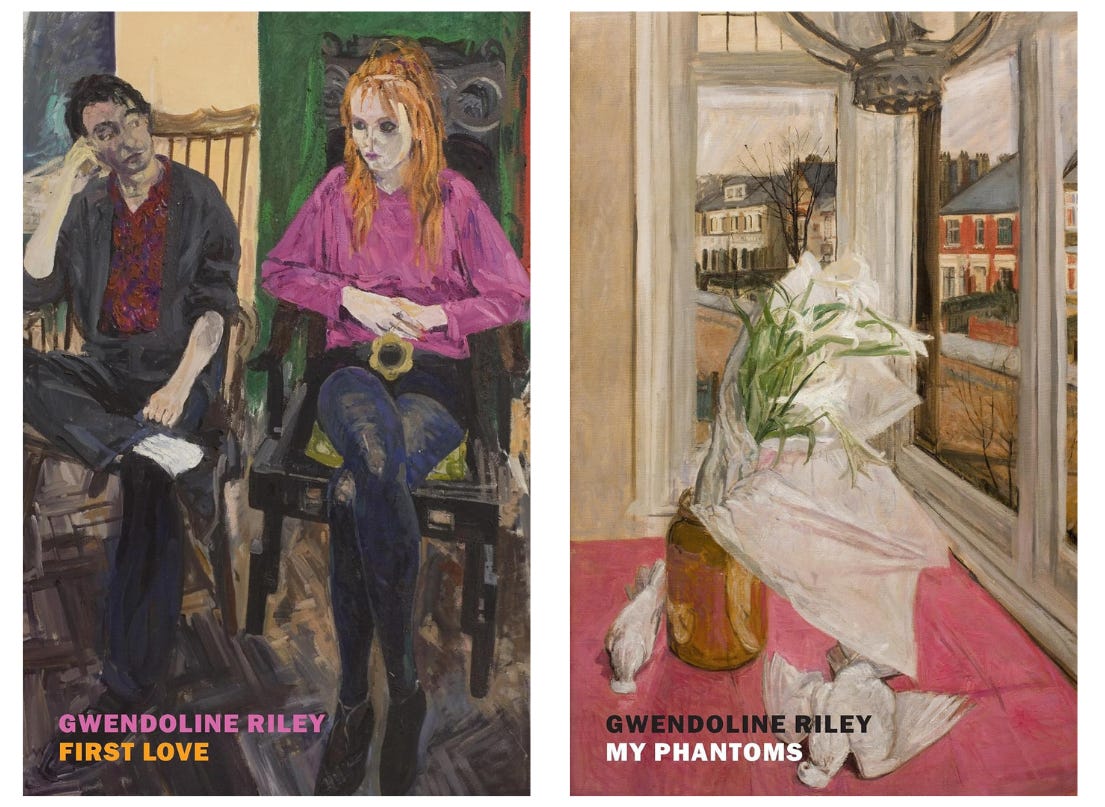
And before I move on — can we have a moment for the NYRB Editions cover art?! For First Love (L), we have Jean Cooke’s Cinema Paradiso (c. 1980s) and for My Phantoms (R), we have Up the Road in Pigeon Pie (also by Cooke).
📚 Red Doc> — Anne Carson
I finished the month with Red Doc> — Anne Carson's follow-up to Autobiography of Red, which I read and reviewed in January. In this one, Geryon is G., older and keeping a herd of musk ox somewhere in a frozen north (at a reading, Carson said that it’s somewhere Upstate NY). His best friend / lover Herakles is back too, renamed Sad. Sad is a war veteran with PTSD, showing up with his damage intact. To live past the end of your myth is a perilous thing, Carson writes as G. and Sad, together with a female artist friend roadtrip across an icy plain, end up in a psychiatric facility, encounter ice bats, etc. The book looks like poetry, moves like a novel, and somehow yet feels like neither poetry nor novel. Carson does not bother to fill in the gap between the two books — the decades of fictional time, the complete change of form, etc — and this novel felt more disorienting to me that Autobiography of Red… It felt to me that Carson maybe was thinking about Geryon and Herakles… and then wrote this book to herself, just to see what if… I found it a little denser and more challenging and hope that commonplacing it will help me see it more clearly.

More than usual, at the end of this month my brain is on an upward spiral of associative reading. I always say that I love to leave a book with at least one other title to push me forward. I ordered Gwendoline Riley’s The Palm House the moment I finished My Phantoms and a triptych of Laings → The Lonely City, The Garden Against Time, and Funny Weather. I already have Anne Carson’s Wrong Norma at home and feel super inspired to continue my journey through the oeuvre. I also picked up Max Porter’s Grief is the Thing with Feathers for another example of a novel in verse.
❤️ Favorite books of 2026 so far:
January — Autobiography of Red — Anne Carson
February — The Copenhagen Trilogy — Tove Ditlevsen
March — Repetition — Vigdis Hjorth
April — Loved and Missed — Susie Boyt
May — Painting Writing Texting — Chantal Joffe and Olivia Laing
It’s wild that we are almost halfway through the year. I have been so lucky in reading but I am also incredibly tired. I have a super fun reader interview to share with you guys next week and then I plan to take a couple of weeks off while we travel to unplug, check in against my reading / writing / human goals and come back to tell you all about it. We are traveling to Madeira for a week and then Bulgaria to visit my family. I am so excited, I can cry.
But before I go today… you know that I always have…
🤓 Some questions for you:
Where are you on the shame to self-acceptance continuum with your reading of the great books?
Do you have a lifetime reading plan?
What are you current reading hyper-fixations? Any overlap with mine?
Sometimes I actually wonder if I may still be too young to truly appreciate them.
Enjoy your break!! It's important to have them (to remember why we like the things we like lol) and you very much deserve it. I hope its restorative and full of good books xx
“That gap between knowing and changing is where I find myself a lot recently and Riley has given me a lot of material to push against as I ponder my own patterns.” THIS! Welcome to midlife.
My reading plan is just to get to as many books on my shelves as I do from the library and also more of the NYRB editions. Two all time favorites came via those and I want more. (Stoner & A Month in the Country)