

Everything I read in July
On solitude, creative life and finding hope by escaping one’s self.

Our next Community Zoom is this coming Saturday, August 1st at 1PM Central. Zoom details are listed under PERKS (in the top navigation). Last time we met we decided to hold a very special show-and-tell call all about COMMONPLACE NOTEBOOKS! Please consider upgrading your subscription and come show us your notebooks!
In Journal of a Solitude, the poet and novelist May Sarton laments the aftermath of a disappointing book review:
I have become convinced since that horrible review (unimportant in itself) that it is a message, however deviously presented, to tell me that I have been overconcerned with the materialistic aspects of bringing out this novel, the dangerous hope that it become a best seller, or that, for once, I might get a leg up from the critics, the establishment, and not have once more to see the work itself stand alone and make its way, heart by heart, as it is discovered by a few people with all the excitement of a person who finds a wildflower in the woods that he has discovered on his one. From my isolation to the isolation of someone somewhere who will find my work there exists a true communion. I have not lacked it in these last years, and it is a blessing. It is free of “ambition” and it “makes the world go away,” as the popular song says. This is what I can hope for and I must hope for nothing more or less.
She is trying so hard to believe that she has grown past ambition, past the need for traditional success… she almost has herself convinced. And it’s painful to read these passages because you can feel her devastation and yet you cannot tell her that, in time, the critics do come around and that decades past her death, her beautiful poems, novels and journals continue to make their way to new readers, heart by heart. And that many of us will experience true communion not only because of how connected we feel to her work but also to each other by discovering our shared interest and affinity for it.
True Communion is a good way to describe my July.
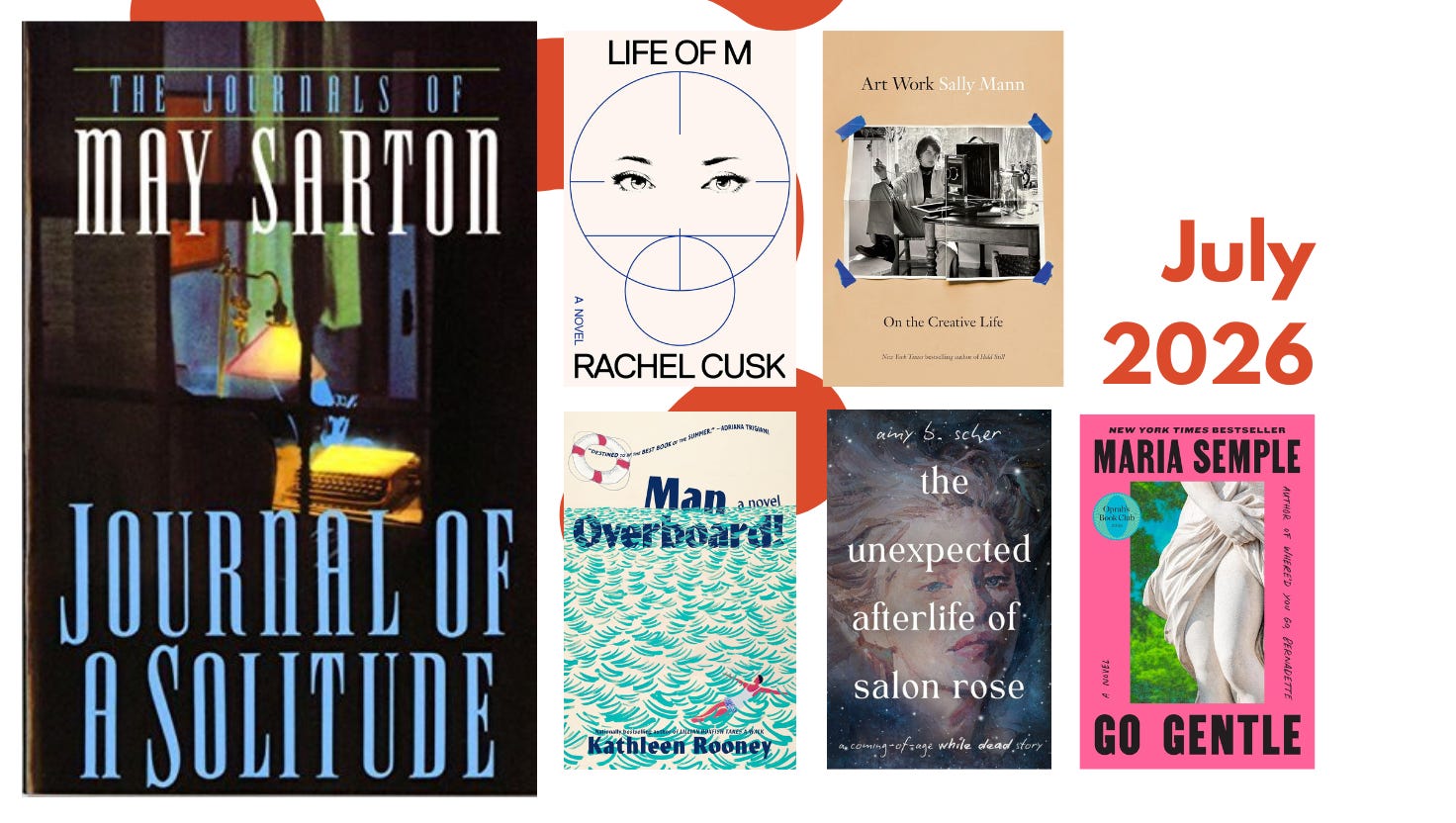
📚 Books mentioned:
Journal of a Solitude — May Sarton
Art Work — Sally Mann
Life of M — Rachel Cusk
Go Gentle — Maria Semple
Man Overboard! — Kathleen Rooney
the unexpected afterlife of salon rose — Amy B. Scher

📚 Journal of a Solitude — May Sarton
May Sarton’s journal was my treasured companion all month long — my favorite book of July, love at first sentence, pages upon pages underlined top to bottom. As I mentioned a little while ago, I have been collecting and reading the work of famous diarists in an attempt to learn how to keep a journal without sounding pathetic to myself. And, with May Sarton, I had my butt handed to me a little bit because her collection is a constant yo-yo between feeling steady and uplifted and feeling deeply lonely and depressed. She falters between being upset about her anger and resentments and being kind and gracious with herself, understanding that her discomfort and despair are the very sources of her creative energy and must therefore be embraced.
What brings her back from the depths of despair:
Nature
Her garden
Writing letters to friends, thought partners, readers
Winning over the stray cat that will take her food but won’t accept her affection
Her lover X
Her fellow townsmen and women in Nelson, New Hampshire
The kindness of simple folk
Being judgy (but fair).
Poetry — reading it, writing it
⚡️ On her time spent with Virginia Woolf:
She was immensely kind to have seen me for at least one tea, as she did for some years whenever I was in England, but in all that time I never felt warmth, and this was starling.
⚡️ The purpose of poetry vs. the novel:
Perhaps because the poem is primarily a dialogue with the self and the novel a dialogue with others. They come from entirely different modes of being. I suppose I have written novels to find out what I thought about something and poems to find out what I felt about something.
⚡️ On lunch:
Lunches are just not good. They take the heart out of the day and the spaciousness from the morning’s work.
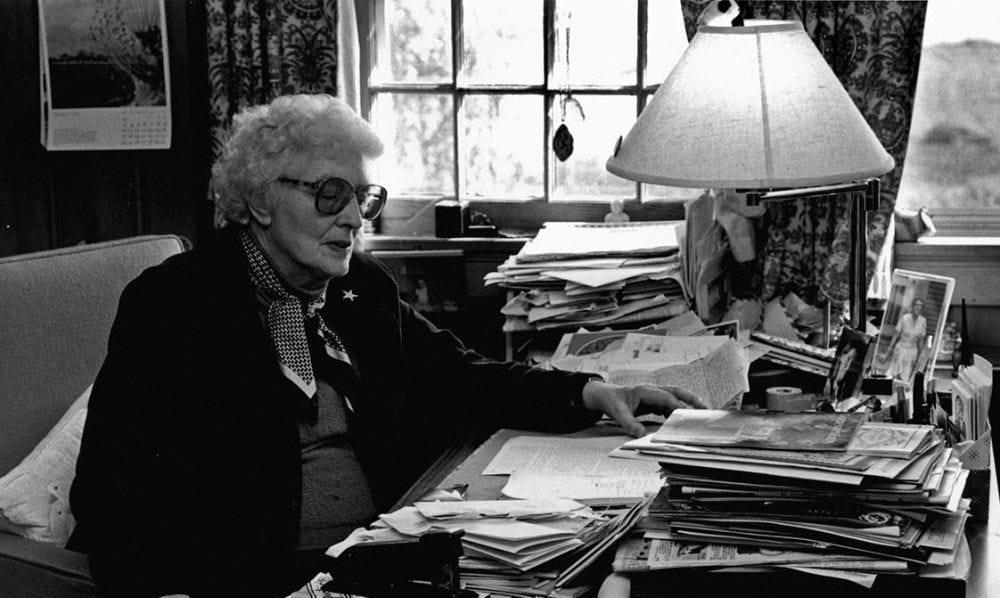
⚡️ On ambition:
Not easy to find the balance, for if one does not have wild dreams of achievement, there is no spur even to get the dishes washed. One must think like a hero to behave like a merely decent human being.
⚡️ On the Flemish painters — Vermeer, Pieter de Hooch:
I suppose these paintings speak to me with such force because they represent all that I hope to do in the novels and in the poems. THey compose the world without ever imposing a rigid schema upon it and make us see even the domestic scene at its most banal with a sudden sense of revelation, with poignant recognition. The painters look at reality with devotion, and what we see is life never sentimentalized, but enhanced.
⚡️ On “long-eared” animals:
Isn’t it true that long-eared animals — rabbits, donkeys — have a special charm?
Last week, during my Zoom Coffee with Khionna Douglas, we talked about how you know you are enjoying a book when you start writing notes to the author in the margins. You may be mad or frustrated with them — but they got you by the neck. All month I have been LOL-ing, WOW-ing, and !!!-ing at May. At some point I even told her, It gets better, May. I truly felt like I met a friend through time and space in this book, not to mention an iconoclastic queer poet who broke both artistic and social boundaries with the singularity of her life and her work. Recommending this book to you all PASSIONATELY and forever grateful to Janet Asante Sullivan for first putting in on my radar so many months ago.
📚 Art Work — Sally Mann
Speaking of iconoclasts, earlier in the month I read Sally Mann’s Art Work — her memoir about her creative life. I, of course, was familiar with Mann’s Immediate Family series that featured her young children in beautiful and provocative poses.
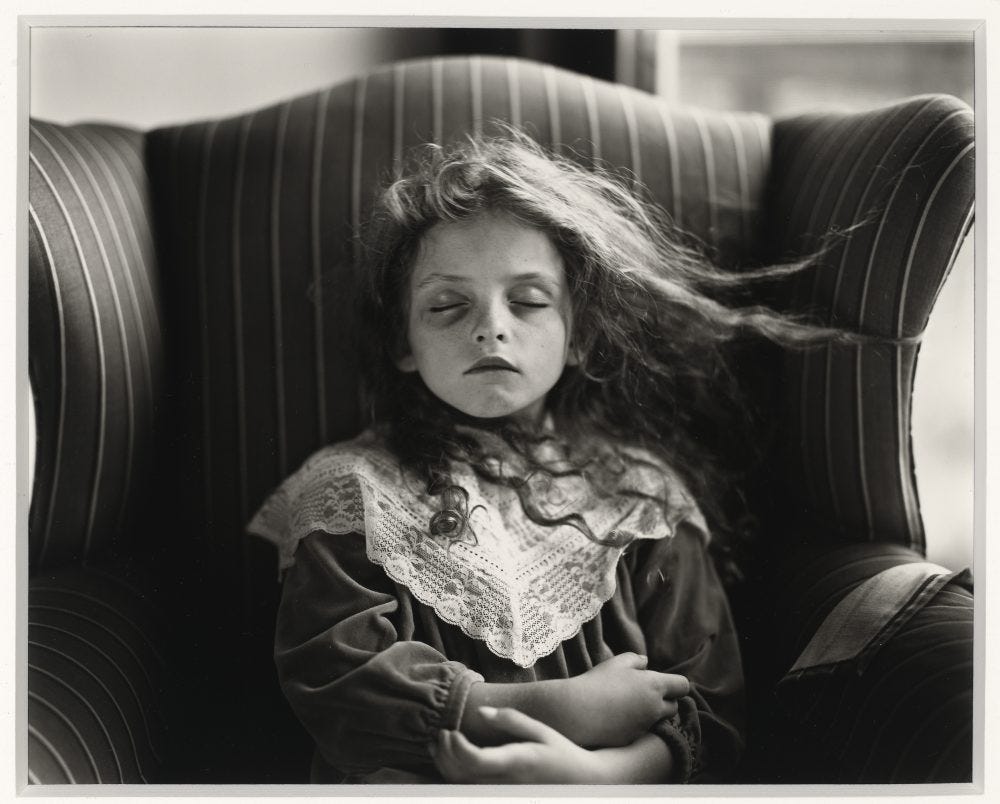
However, I was not familiar with Mann’s larger body of nature photography NOR with her writing, and the memoir actually made me love her even more. Because of my entryway into her work (through the children portraits), I had always thought of Mann as a shit-stirrer and a provocateur… but her memoir helped me see her as a sensitive poet at heart. Her spirit is warm, elegiac and very Southern… inspired by the land, its ghosts and its history and reflected not only in her writing but in her nature photography as well.
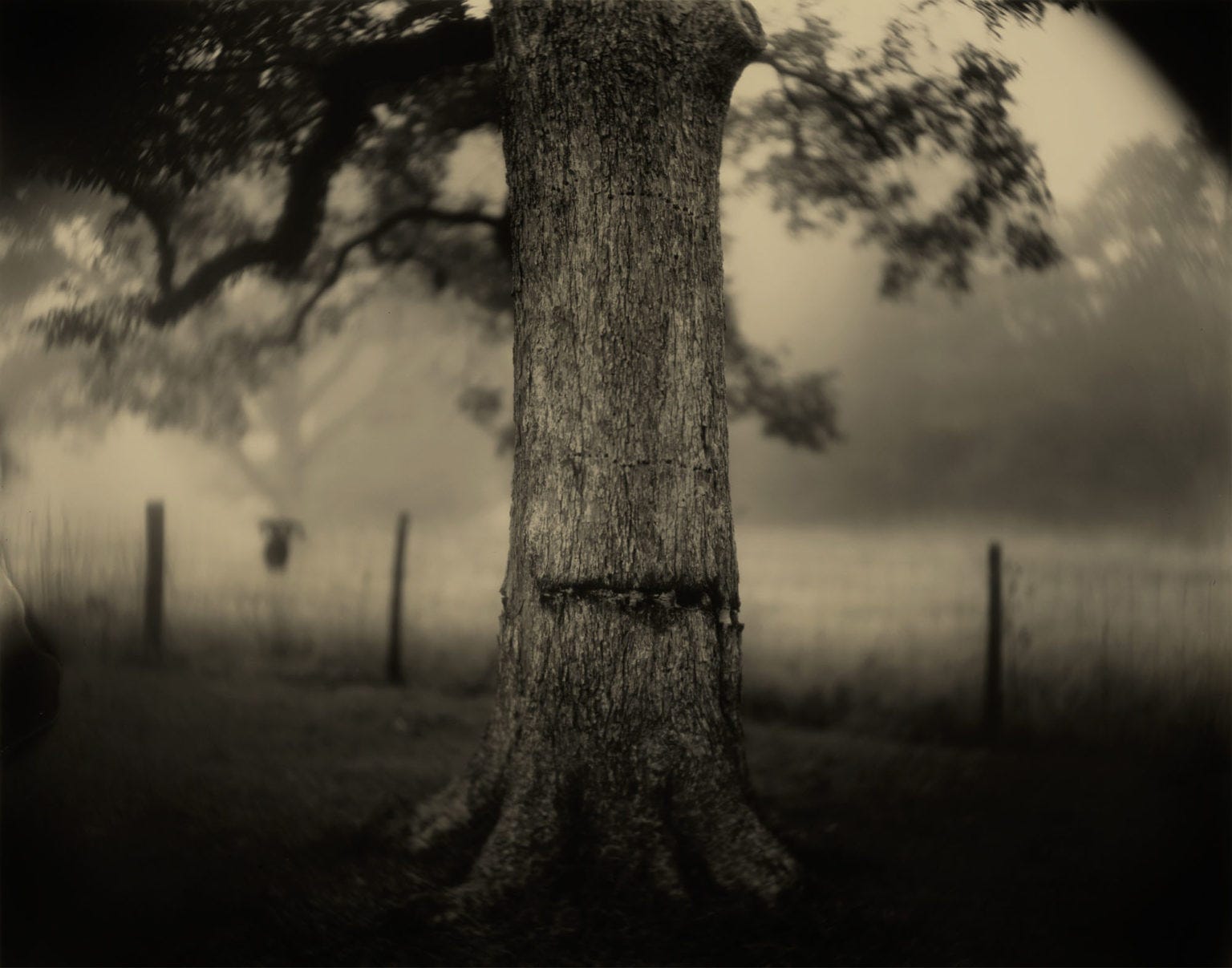
Mann wrote the book with young artists in mind — to show and encourage them to stay with their work and continue to push through the pain of creation as that pain is easier to endure than the pain of not producing your work1. She is an equal advocate for both order and passion in one’s artistic pursuits and on multiple occasions leans on Flaubert:
To paraphrase, indeed mangle, my hero Flaubert, you should be regular and orderly in your life, so you can write like an avenging angel.
In the context of the month that I was having, I was fascinating by the inclusion of many diary entries (reproduced as photographs, which was really neat to see) and letters with the photographer Ted Orland who Mann met early on in her career while attending the Ansel Adams Gallery Yosemite Workshops. Their prolific correspondence spanning decades is a constant source of strength, clarity and levity for Mann who for years struggles to find her path into the art world and to be taken seriously. And even though the book is definitely written for a younger audience, I felt genuinely inspired by the clarity of Mann’s vision and her insistence on staying with an idea for as long as it needs to be fully formed. Sadly, most good things require that you have the patience to put in the work and… alas… TIME.
📚 Life of M — Rachel Cusk
The BIG novel for me this month was Life of M — Rachel Cusk’s new novel that is about to hit bookstores in late August. True to form, the book is set in an unspecified European city (that feels a lot like Paris) and puts an unnamed novelist (that feels a lot like Cusk) in conversation with her famous actress friend — M — about the quality and nature of her life as an incredibly recognizable person in the world. The story opens with the narrator telling M that she is thinking about writing her “autobiography” and the actress likes the idea. The narrative that follows alternates between descriptions of the two women’s direct interactions over the course of their friendship — book events they attend together, long conversations in M’s garden — throwbacks to M’s earlier artistic projects and the narrator’s personal reflections on the meaning of an artistic career and the impact of celebrity on one’s ability to cultivate and maintain a stable sense of self.
If you are already familiar with Cusk’s work and follows literary gossip, you are probably already aware that the book is apparently based on Cusk’s friendship with Natalie Portman and that Natalie Portman is, allegedly, not happy about how the book makes her look. I personally do not care about celebrity culture — all my favorite celebrities are novelists with two notable exceptions2 — and early on found this particular theme of the book a little offputting. Like, I know that Cusk’s work is typically autofictional and therefore, the M character was probably based on an actual person. Once I learned that the character was based on NP, I could see how certain references could be interpreted to be directly borrowed from her career. But, to me — honestly — it all read like it could have been any other actress who started in the industry as a young child, got to play a number of overly sexualized roles and then had to fight tooth and nail to build a reputation as a person of intellect and substance.
Note: Similarly to M in the novel, Natalie Portman has had a long partnership with Dior and has participated in book events for / with the brand. Portman also has a bookclub that seems to have stopped running in March of 2026.
I am sad and annoyed that the book has already become “The Natalie Portman Book” when, to me, the most interesting aspect of it was the fluidity between the narrator and M’s narratives and how much the two needed each other in order to validate their own ambitious pursuits. M, for example, meets the narrator at a reading and is quick to allow the friendship as she is looking for proof of her own intelligence and high-mindedness. The Cusk-esque character in turn is carefully documenting the transparent nature of M’s continuous metamorphosis while gradually acknowledging the instability of her own personality:
Our personalities seem like strangers to us. It is this self, unanchored in time, breathing in the darkness, that is real.
More than a commentary on celebrity culture and/or female exploitation in the film industry (which, somehow, I cannot imagine Rachel Cusk giving a flying fuck about) — I read the book as an exploration of the concept of “no-self.” There are not explicit mentions of this idea but in Buddhism, anattā, is the idea that contrary to Western ideas of selfhood, humans do not have a core, fixed, “authentic” self but are, instead, a changing mix of physical and mental processes: physical form, thoughts, perceptions, feelings, awareness, etc. and therefore it is futile to keep searching to uncover an “authentic self.”
I find the way in which Cusk draws out this idea of no-self in this book both incredibly moving and also delightfully familiar as echoes of Cusk’s earlier work: the interplay of professional ambition, family and age in this new novel at times feel like a throwback to both the Outline trilogy — especially Kudos — and the devastating honestly of A Life’s Work — Cusk’s memoir of becoming a mother. From the current vantage point, it appears that Cusk has developed a softness and an acceptance that her younger self was not ready for. In describing M’s strife — for creative singularity, for erudition, for social approval — she is able to relinquish the “ugliness” of her own experience. She’s dealt with that ugliness in the past “by trying to pay attention to myself.” But through documenting someone else’s inability to accept the permeability of their self, she is finally able to let go of her own and what at times in her life has felt like catastrophe can now feel a whole lot like freedom.
I know that these are strong words… but this is probably my most favorite novel by Cusk yet. 😳

Because it was July, it felt appropriate to take my foot off the pedal a little bit, readingwise and I read three “lighter” novels that kept me reading while making endless tomato sandwiches, supervising playdates or trying to convince my sweet aging dog to go for a walk in the sweltering Memphis heat.
📚 Go Gentle — Maria Semple
Go Gentle is Maria Semple’s latest novel. Semple is the author of Where Did You Go Bernadette which is one of the most FUN novels I have ever read. I will read anything that Semple writes but I already know it’s never going to quite match Bernadette for me. This book follows a middle-aged Philosophy professor who teaches stoicism and is a moral advisor to a wealthy family. Life is good as she enjoys her work and her life as a divorced parent of a clever teenager when she gets mixed up in what feels like a heist that puts both her personal and professional life in jeopardy. The book is a romp — between the stacked cast of characters and the quick snip of the plotline, I must confess that at times I couldn’t quite follow who’s who and how the various clues tied together. BUT, Maria Semple’s signature mixture of wit and delight covers up any try-hard indiscretions… so, I too, will go gentle on her.
📚 Man Overboard! — Kathleen Rooney
I also read Man Overboard! by Kathleen Rooney — about a man who finds himself bopping in the ocean, apparently after having flipped overboard while on a cruise with his family. He is unsure if he’s fallen or if he’s jumped but present circumstances have him fighting to survive. The book is equal parts funny and tender, reminding me in voice and tempo of Dolly Alderton’s Good Material and maybe some of Nick Hornby’s work… while also giving me some of the sadness and anguish of Richard Yates’ Revolutionary Road (I know, I know… an odd set of comparisons but I stand by it). Thank you, Amran Gowani for the recommendation!
📚 the unexpected afterlife of salon rose by Amy B. Scher
Finally, I finished the month with the unexpected afterlife of salon rose by Amy B. Scher. This book — wildly and unbelievably inspired by real-life events — is told by Salon Rose who opens up on page one by sharing, “the first dead body i ever see is my own.” The book is part murder mystery, part coming-of-age story and is inspired by a horrific week in Scher’s life when her father died and her twenty-two year old cousin — Salon Rose — was murdered. In the opening to the novel, Amy shares that she survived her grief by “listening to true crime podcasts, carrying my dad’s ashes around in the toothpick holder he used for weed, and writing this book to try to find meaning in it all.” The story is odd, funny and full of heart… but my favorite part about it was the voice of Salon Rose who basically rings off the page. It’s an imperfect reference… but the book really made me want to rewatch Juno. Who remembers it? Also… reading it, I just kept thinking… how fucking amazing humans are that we are able to take our most profound broken-heartedness and transform it into art that is both silly and hopeful.

My reading this month felt extra special because I spent a lot of time grabbing Zoom Coffee with so many of you guys and getting to chat about books, newsletters, journaling and the weird joy of making real friends on the internet. I was again reminded of how much I value my book friends while reading Kim Ourada’s responses to The Reading Life questionnaire last week3.
There are many reasons to be a reader and a writer on Substack — I do know that many people are building SERIOUS careers on this platform. But to me the best part, always, is the connections and conversations I made with other readers and I will never stop feeling grateful for that.
❤️ Favorite books of 2026 so far:
January — Autobiography of Red — Anne Carson
February — The Copenhagen Trilogy — Tove Ditlevsen
March — Repetition — Vigdis Hjorth
April — Loved and Missed — Susie Boyt
May — Painting Writing Texting — Chantal Joffe and Olivia Laing
June — Show Your Work | Keep Going | Don’t Call It Art — Austin Kleon
July — Journal of a Solitude — May Sarton
I hope your July has been fun and I look forward to seeing some of you on our Community Zoom this coming Saturday! Please bring your Commonplace Notebook if you have one and be prepared to do a QUICK show-and-tell on how you do it! If you are unable to upgrade your subscription but would like to attend, be sure to send me a note and I would be happy to comp you!
🤓 And… before I go:
What was the BIG book of your month — the one that you carried around and organized your life around?
For Cusk stans — is the Natalie Portman drama making you more or less excited to read this book? And can you please promise me that you WILL read it so we can talk about it some more?
And, finally, isn’t it true that long-eared animals — rabbits, donkeys — have a special charm? Donkeys are my favorite animals. 🥹
I whole-heartedly agree!!!
I once started running after Anderson Cooper in front of the Altes Museum in Berlin and my husband dutifully tackled me down to the ground to save me from myself. I also told Morgan Freeman I wanted to lick his face. In front of my mother-in-law.
Kim AND her notebooks will be joining the Community Zoom on Saturday. I know so many of you loved looking through her pages and took a lot of inspiration from her book journals (me included).
Your favorite cusk!!!!!! Have been eagerly anticipating and am now even more excited!
Looking forward to Cusk's LIFE OF M.
I had two July books that stuck with me: FAMILY HAPPINESS by Laurie Colwin and THE NAMESAKE by Jhumpa Lahiri. Both excellent.