

Everything I read in December + first *No Book Assigned* Bookclub of 2026
Good things happen to those who manage to chill the fuck out


Hi! I am so glad that my planning post resonated with so many of you! I have loved hearing about your own systems and philosophies and the notebook porn has been unreal! More please!
On that note: our next No Book Assigned Bookclub will be happening on Zoom this coming Saturday, 1PM Central. We typically cover MANY topics but the focus this time will be on reading goals. If you are working on adding more intention to your reading in 2026, I think you’d really enjoy being in conversation with other dedicated readers and learning from one another. The No Book Assigned Bookclub is one of the perks I offer for paid subscribers and to make it easier to join, I am offering 26% off annual subscriptions between now and Saturday. If you are interested in joining but for whatever reason are unable to upgrade, please let me know! I know people. 🤭
The details to our Zoom will be emailed to all paid subscribers on Thursday.
December is typically not a great time for me reading-wise. I panic that the end is near and try to catch up while work and personal obligations pile up. Instead of feeling grateful and reflective, I feel frazzled and disappointed. It’s the worst of me. BUT THIS DECEMBER WAS DIFFERENT. A couple of things happened that made it so:
✨ 1| When I started planning my December, I told myself to accept that work would be busy (people were NOT circling back nearly enough!!!) and also that I should make myself emotionally available for my kid, who’s 8 and in peak holiday spirit. December was simply not going to be the time to get a lot of me-time. I was right. And I wasn’t bitter or resentful about it because I had anticipated it. And then — the weekend before Christmas — Rumi figured out that Santa wasn’t real. I felt incredibly grateful that I’d already set aside that weekend for holiday prep with her and was available to pivot and indulge in the magic of Christmas which she now knows comes not because of the existence of a magic men but because of the profound love humans feel for each other.
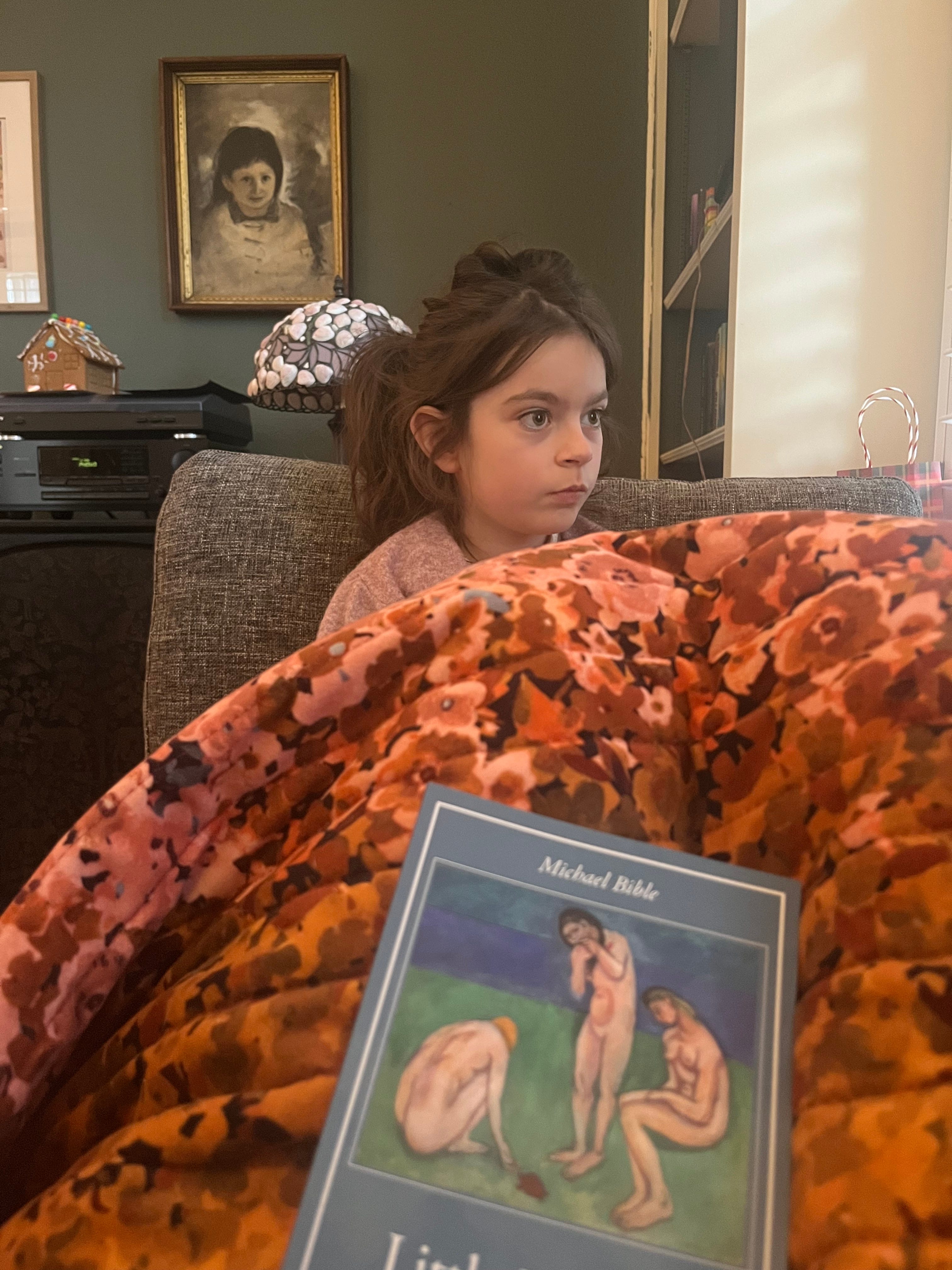
✨ 2| I had finished November on an extremely high note when I finally completed Anna Karenina. Reading Anna Karenina has been such a lifelong dream for me and loving that book felt so incredible. I was happy and proud and that buzz just stayed with me for so long. In a way, it didn’t matter what would come next. I.HAD.READ.ANNA.KARENINA. And, finally:
✨ 3| During my Live with Sara Hildreth, I got the brilliant advice that one way to avoid holiday reading stress would be to focus on reading a really good BIG BOOK. I read what I read but, ultimately, I was just looking forward to hopping on a plane the day after Christmas and sinking into Helen DeWitt’s The Last Samurai — the book had been on my radar for a while but ESPECIALLY after reading about it in Sarah Chihaya’s memoir, Bibliophobia. Doorstop December became a thing and I’m here to report from the other side — it’s the best thing that could have happened to me!
Quite predictably, then, when I figured out how to calm the fuck down — I was in turn able to have a lovely month of reading in bursts big and small. Not only did I enjoy everything I touched, but I also managed to read a book with friends AND devoured a novel by an author I am now trying to add to my completionist list. All in all, an excellent way to close out an already stellar year.
I love that I am finally in a stage of life where I have not only learned some lessons but I also have the wherewithal to live by them.
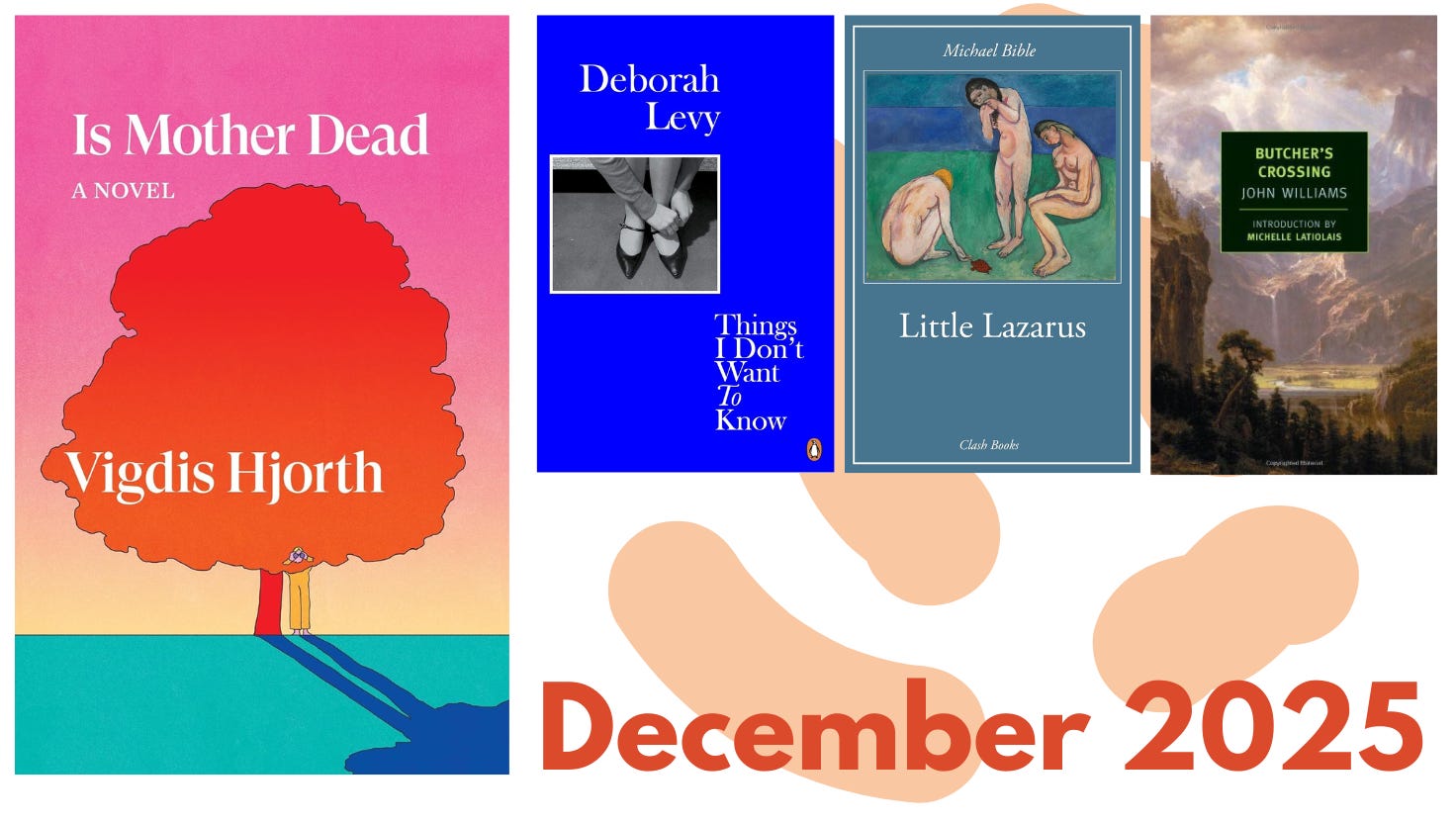
📚 Books mentioned:
Things I don’t want to know: On writing — Deborah Levy
Little Lazarus — Michael Bible
Butcher’s Crossing — John Williams
Is Mother Dead — Vigdis Hjorth

📚 Things I Don’t Want to Know: On Writing — Deborah Levy
Things I Don’t Want to Know is Deborah Levy’s first volume in her Living Autobiography trilogy and a response to George Orwell’s essay Why I Write. Levy reframes Orwell’s four motives — political purpose, historical impulse, sheer egoism, and aesthetic enthusiasm — through the lived experience of a woman writer navigating personal history, gender, and the act of writing itself. Levy moves across continents and decades — from South Africa to England, through Europe, and across different moments in her life — showing how her relationship to writing was shaped by geography, politics, and family.
We meet Levy as a child in apartheid-era South Africa, where her family’s emigration echoes political upheavals and personal dislocation, and again as a teenager in England, “playing at being a writer in the company of builders and bus drivers in cheap diners,” trying out the idea of self. Across these scenes, writing is not an abstract craft but a behavior, something you do in the margins of life — in awkward cafés, waiting rooms, and rented rooms far from home.
To become a WRITER I had to learn to INTERRUPT, to speak up, to speak a little louder, and then LOUDER, and then to just speak in my own voice which is NOT LOUD AT ALL.
The book is a song to a life lived in different worlds, pivoting between political history and the intimate struggles of voice and identity. It’s a slim book, but it carries the weight of decades.
📚 Little Lazarus — Michael Bible
Little Lazarus unfolds along two paths: one intimate and human, the other strange, slow, and almost mythic. At its center are Francois and Eleanor, two lonely teenagers growing up in a small Southern town called Harmony. Both are shaped by emotional absence and familial neglect, and when they find each other, their bond feels immediate and urgent. Being together offers the possibility of escape from lives that already feel foreclosed.
Their story builds toward a pivotal night on a country road, an event that fractures their lives. But the novel is less concerned with what happens next and more focused on how people live with what has happened. Guilt, grief, longing, and memory settle in, altering the shape of adulthood.
Running alongside this narrative is the story of Lazarus and Little Lazarus, two clairvoyant tortoises (yes, you read that right) who pass through centuries and across continents. Nearly immortal, they move from caretaker to caretaker, strangers who briefly intersect with their long lives before disappearing. Through them, the book widens its lens, placing individual suffering inside a much larger temporal frame.
At first, this structure feels whimsical, playful… even absurd. But over time, it becomes devastating. The tortoises act as witnesses, reminding us how brief and frantic human life appears when measured against deep time. It’s a novel that asks for patience and openness — and rewards both with something tender, unsettling, and hard to forget.
📚 Butcher’s Crossing — John Williams
I read this book with Mike of Books on GIF and Martha of Martha’s Monthly . We all loved it.
Set in the 1870s, Butcher’s Crossing follows Will Andrews, a young, Harvard-educated man who abandons his comfortable life in search of authenticity and meaning in the American West. He arrives in the small Kansas town of Butcher’s Crossing and joins a buffalo-hunting expedition led by Miller, an obsessive, taciturn man determined to locate a rumored untouched herd deep in the Colorado Rockies.
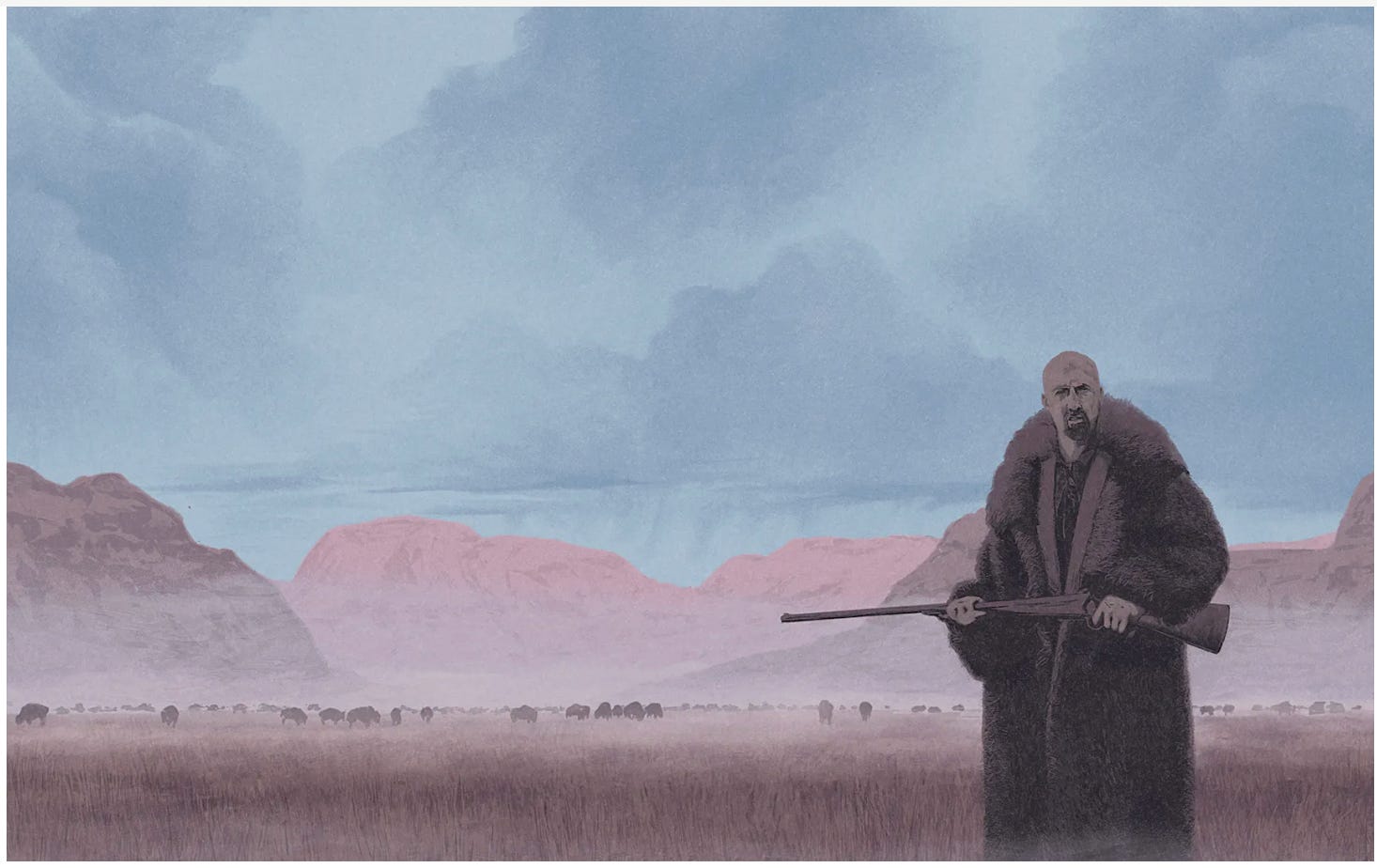
The journey that follows is grueling and unforgiving. Williams devotes long, rumbling passages to the mechanics of the hunt — the mass slaughter of buffalo, the physical toll of isolation, hunger, and winter, and the gradual erosion of morale. Andrews begins the expedition believing in transcendence through hardship and communion with nature. What he encounters instead is excess, futility, and moral vacancy.
What makes the novel so unsettling is its methodical dismantling of the frontier myth. This is not a story of rugged individualism or noble endurance. It’s a story about obsession — about what happens when an idea (purity, truth, mastery, wealth) becomes more important than consequence. Miller’s single-minded pursuit of the hunt feels less heroic than pathological. Andrews’s idealism is slowly stripped away. He is not enlightened but emptied out, forced to reckon with the damage done in the name of meaning.
Williams’s prose is sober and precise, and the emotional impact accumulates slowly but steadily. Butcher’s Crossing feels eerily contemporary in its critique of extraction, ambition, and the fantasy that suffering itself confers value. As I have mentioned MANY times before, Stoner by John Williams is one of my life-ruiners and because of that, I had resisted reading this book for fear of destroying my perfect opinion of its author. I should not have worried.
📚 Is Mother Dead — Vigdis Hjorth
Is Mother Dead centers on Johanna, an artist who abandons law studies and family for an artistic life in America, leading to a deep rift with her conservative family, particularly her mother. The catalyst of the story is a major retrospective of Johanna’s work — work that draws heavily on her childhood and family life. When her mother refuses to attend the exhibition or acknowledge her success, Johanna is pulled back into a confrontation she has long tried to avoid.
The book unfolds largely through Johanna’s interior monologue and memories. She revisits her childhood, her parents’ emotional coldness, and the long-term impact of maternal rejection. The narrative is insistent and repetitive, circling the same emotional wounds again and again. There is no dramatic revelation and the long-anticipated confrontation between the daughter and her mother does not resolve the tension that frames their relationship.
The book is equal parts difficult and compelling. Johanna’s pain feels real and justified, yet the novel resists turning her into a straightforward victim. Instead, it stays with the discomfort of unresolved grievance: the way old injuries harden over time, the way telling one’s story can feel both necessary and isolating. The book suggests that some relationships do not heal; they calcify. Is Mother Dead felt reminiscent of Will and Testament in its reflection on the the cost of truth-telling — especially for women — and the uneasy freedom that can come from finally refusing to soften one’s account for the sake of peace. This is only my second book by Hjorth but I am now officially a stan.

How was your December for you? What stopped you in your tracks? What was the most beautiful? Did you read anything long?
❤️ Favorite books of 2025:
January - Pond by Claire-Louise Bennett
February - Open Throat by Henry Hoke
March - Swimming Home by Deborah Levy
April - Assembly by Natasha Brown
May - The Wilderness by Ayşegül Savaş
June - Checkout 19 by Claire-Louise Bennett
July - Long Distance by Ayşegül Savaş
August - The Wall by Marlen Haushofer
September - Big kiss, bye-bye by Claire-Louise Bennett
October - The Other Girl by Annie Ernaux
November - Anna Karenina by Leo Tolstoy
December - Is mother dead by Vigdis Hjorth
I added Butcher's Crossing to my Want to Read list. It sounds wonderful.
Rumi...😢 I'm glad to hear that bookstore trips and Gilmore Girls worked their magic✨️
What a great reading year, and we get to do it all again in 2026! Happy New Year 🧡