

Appetite
"On Eating," reading, wanting, and coming alive to yourself

There is something terrifying about becoming a woman who writes on the internet, especially when your personal path has not followed the standard trajectory and your object of study does not coincide with the canon. As much as you own your journey and do the work of backfilling your intellectual lineage, you are eventually faced with the possibility that you may in fact be a philistine.
I have been convinced that taste is not the same as having a clear articulation of your personal preferences. Taste is a very specific kind of knowledge that I aspire to acquire. As Henry Oliver writes in his now famous essay on the subject, having good taste in wine means being able to identify what you are drinking, being able to distinguish various grapes and regions. Having good taste in literature means knowing what you are reading, where it sits, what it is doing. It took me a while to realize that despite having missed it early on in life, that knowledge is still attainable for me. But even as I continue to surprise myself with how much I genuinely enjoy and appreciate classic works of literature, I still feel a certain discomfort with the idea that to truly claim taste, I need to aspire to a belonging that has historically not cared about me and my people.
Especially because whenever I allow myself to explore and trust my own preferences, I find myself rewarded — drawn into an intellectual lineage that is literary and erudite, but also emotional, corporeal, and, importantly, inclusive. When I let myself feel a sense of belonging alongside writers like Deborah Levy, Annie Ernaux, Kate Zambreno, Lauren Elkin, or Rachel Cusk, a familiar doubt creeps in. Is this comfort real? Is it earned? Who the fuck do you think you are, aligning yourself with writers so far out of your league?
But I didn’t arrive here by accident. It took real work to find my way into this space — work that was not always pleasant or easy. So when I catch myself wondering whether I’m just self-soothing through these books, I have to push back. Was reading A Woman’s Story supposed to be comforting? Was it fun?
I talked to several of my favorite readers about taste last year:

And continue to work through what it’s like to read in a way that is almost universally dismissed by serious critics:


I don’t mind working for taste. I just refuse to apologize for my preferences. And it is from inside that tension that I want to talk about Alicia Kennedy’s new memoir.
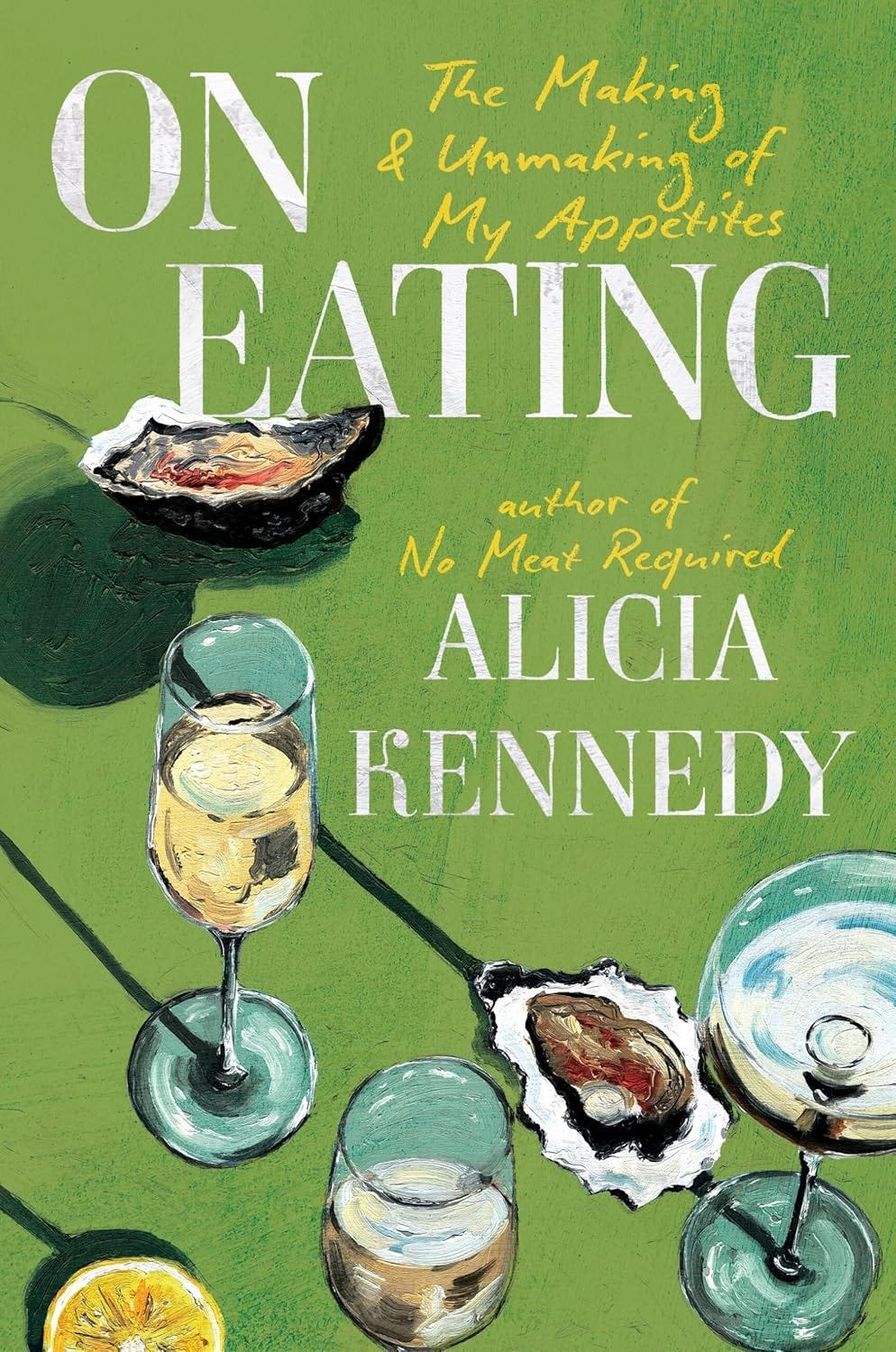
On Eating: The Making and Unmaking of My Appetites just came out this week. It is AK’s second book in English and an extension of her work as a food journalist, academic, and essayist. Many of you will already know her from her incredible newsletter, From the Desk of Alicia Kennedy and here’s a peek into her reading life as told to yours truly:

The new book is organized around the foods and ingredients that have shaped her life: apples, lamb, mushrooms, oysters, coffee. Through stories of coming of age on Long Island and building a career in New York City and later San Juan, she weaves personal narrative with well-researched food histories and sharp observations on a food industry that presents as creative and desirable but has been built on exclusion and exploitation. It is a book about becoming: about learning how to want, how to discern, and how to make a life around those instincts. As someone raised to associate food preparation with the subjugation of women and anything remotely domestic with servitude, the fact that I am deeply invested in this writing continues to astonish me. It is a massive testament to Alicia’s writing and, specifically, her ability to work on multiple registers at once: memoir and cultural history braided together, behind-the-scenes honesty about food writing as both craft and profession, and a refusal to romanticize a life that is often aestheticized from the outside.
Alicia’s professional journey is almost accidental. While working as a copyeditor at New York Magazine, she takes up vegan baking as a form of stress relief, soon finds herself running a small business selling birthday cakes to Long Island vegans, and little by little builds a writing portfolio by pitching online publications. She becomes a restaurant writer for The Village Voice (RIP), and when the publication folds, takes the push to go freelance. Vice Magazine sends her to San Juan to write about piña coladas, where she adopts, in her words, “a Bourdainian posture” for the first time. It is cocktail writing that opens up the world for her: Scotland, Italy, Mexico, and beyond. She discovers she does not care for wine but loves learning about the history and politics of what people drink and why, finding along the way that she is not just competent at this but genuinely, voraciously interested.
The chapter on martinis made me nervous to read, and not because I am especially anxious about alcohol. I felt nervous for her as she described walking into a male-dominated space, a world of bars and tastings and industry events and professional drinking, and simply not being afraid. She is curious, she is hungry, she is willing to go. She does not manage herself into smallness. She simply follows her appetite into the room and finds out she belongs.
My reaction made me wonder how much of my formation as a woman has been about staying small, staying gentle, staying legible, staying safe. The fear I felt reading Kennedy in that bar was not fear for her. It was recognition of something in myself that has spent a long time keeping many doors closed. A woman who follows her appetite into a room that wasn’t built for her, who drinks what she wants and writes about it and gets paid and comes back for more: that is supposed to be dangerous. Except it isn’t. It’s just a woman becoming alive to her own life. This is what appetite looks like when it hasn’t been fully domesticated.

Appetite is Kennedy’s driving force and, I think, the most useful concept this book offers to anyone trying to think about how we know what we know and why it matters. Alicia describes it as the hunger that’s not hunger but a greedy voraciousness, and I love how active and momentous that feels. It is restless. It starts in the gut but does not stay there. It is specific to your body and your history and your grief and the particular moment you are living through. And crucially, it is NOT the opposite of knowledge. When vegan baking takes Alicia down the artisanal chocolate aisle of a specialty grocery store, she intuitively embarks on a journey that will not only influence her baking but will teach her about “how food comes into our hands, especially in the affluent global north,” and will ultimately shape what she wants to write about. Appetite, followed honestly outward, does the same work that accumulated knowledge does. It expands you. It builds, over time, into something that looks very much like taste, except that it was generated from inside rather than aspired to from without.
This feels especially significant given that women have historically been denied appetite as a serious category. Female hunger, whether for food, sex, power, knowledge, or recognition, gets pathologized, moralized, or domesticated. While male chefs, Alicia argues, have been allowed to cook from intellect or self-expression, women do so in service of others. We cook for our families, to feed our children, to nourish our community, to be useful. The acceptable version of female hunger is hunger that disappears into care.
This shows up in reading too. The idea that a woman might read to satisfy her own hunger, not to improve herself or become a better citizen but simply because she wants to, has always carried a faint whiff of defiance. I feel it every time I choose a book because it calls to me rather than because it appears on a list I am “supposed” to be working through. I feel it every time I defend emotional, embodied reading as a serious mode of engagement rather than a warm-up for the real critical work.
“This is something I have been slow to admit — Alicia writes — that I have a unique relationship to food that has never been punishing.” I find that attitude endlessly inspiring. I read her not with other food writers but with the authors who compose my own personal canon: Deborah Levy, Lauren Elkin, Kate Zambreno, Annie Ernaux1. What connects all of them, and what connects them to Kennedy, is that they write the self as a serious critical and political act. The interior life, the body, desire, appetite, grief, place: these are not warm-up material for the real argument. They are the argument. And none of these women are writing in service of anything or anyone else. The world may be interested in forcing them into a defensive position, but they refuse to submit. They insist that their hunger is serious.

If you have ever felt caught between the reader you are and the reader you think you should be, between the hunger you already have and the taste you are still working toward, I hope you find your way to this book. Kennedy will not tell you to work harder or want differently. She will give you a word for what you are already doing and show you how seriously that doing can be taken. How far it can take you. How much it already knows.
🤓 Now tell me:
How do you distinguish between preference, appetite, and taste in your own reading life? Do those feel like different things to you?
Have you ever felt undeserving of the books you love—like you somehow hadn’t “earned” your place among them?
What would it look like to follow your intellectual or creative appetite more fully—and what, if anything, is stopping you?
So many of these writers are referenced in On Eating which was a special kind of delight!
Wonderful article. I don't worry about my place in things, anymore. I love to learn, and am grateful to anyone who writes or has written books that make my life richer. Happy to be alive and with people I love. Perspective. Calm.
These are great questions. It is hard to describe taste, and education may help develop it, but that's not the only way, I don't think. Observing the natural world and its patterns and relationships is another education and offers plentiful examples of proportion, pacing, balance, and so on. It is helpful to know the agreed upon terms for things, as naming always refines, and I find it makes a difference to write about what you read, as you do who well here. Why is something good? Why doesn't everyone see it the same way?