


FRAGMENT, I am a fragment of us. I am a fragment composed
of fragments. Mosaic, pastiche, ruin. Everyday
consciousness proposes lightbulb, ropeswing, teapot,
David Bowie, your sweater on, your sweater off, tomatillo,
all associated. Parts suggesting the whole
they long to be gathered into.
― Rebecca Lindenberg, Love, an Index
Today’s reader is THE COOLEST.
Jacqui Devaney is one of those rare readers who take the act of reading and make it into something larger — an artform that extends outward into writing, music and community. She’s a writer, a DJ, and the creator of Dinner Music, a weekly newsletter of playlists and album recommendations that arrive with the same kind of close attention that you will see below she brings to her reading. Reading shapes her writing, her writing shapes her DJ sets, and her sets become another form of storytelling altogether.
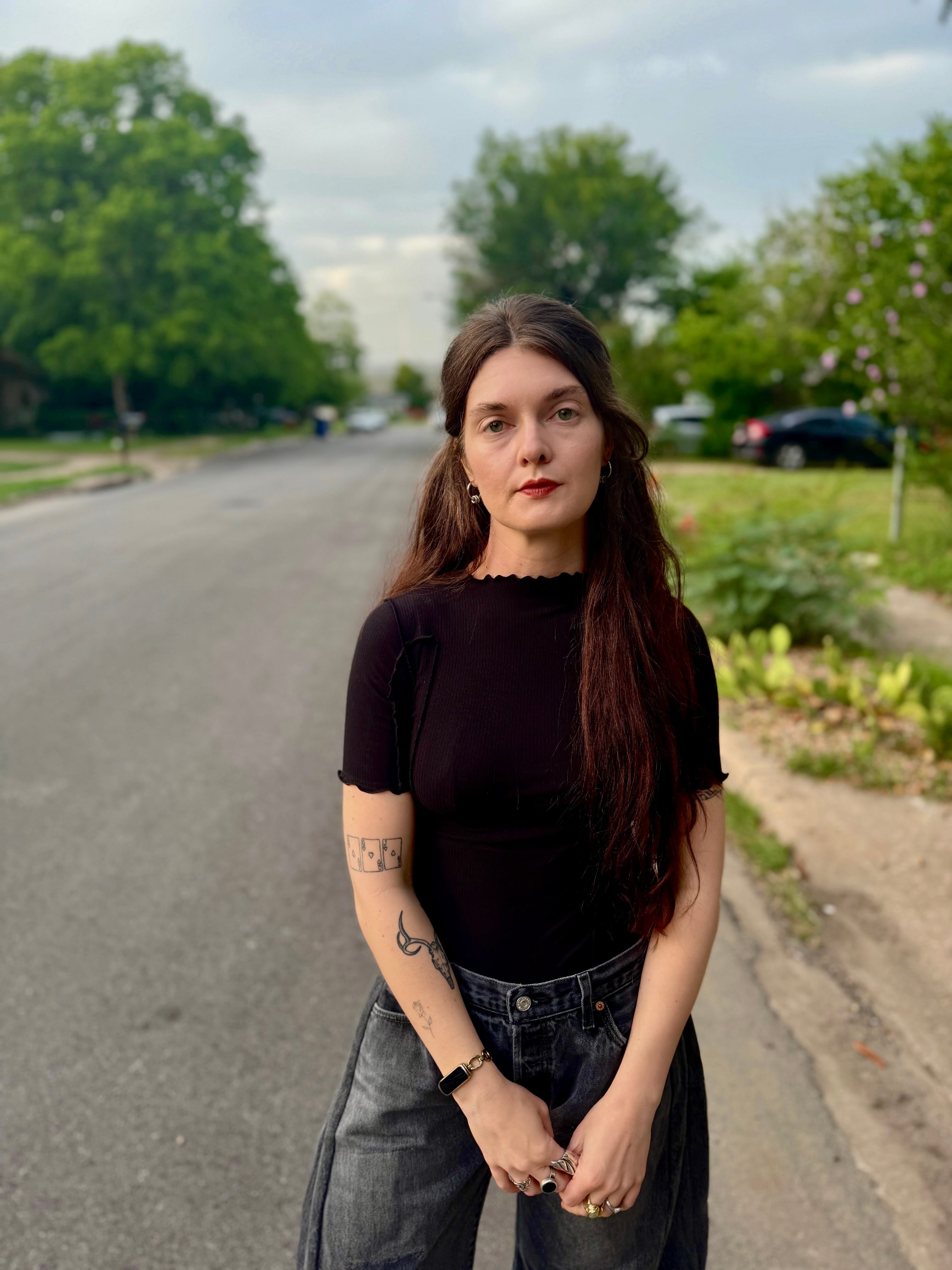
What I love about Jacqui’s work is the way it resists sameness. In a moment when so much of what we listen to is assembled by opaque systems, she offers something unmistakably human. Her selections never feel interchangeable; they carry the kind of small, specific choices you can only get from someone who has been listening, feeling and paying attention. It’s the difference between something that passes the time and something that opens a window… you know it instantly, even if you can’t explain why.
Jacqui reminds me that being a reader isn’t just about books. It’s about cultivating a life of inquiry and resonance, about weaving the stories we take in into new forms. She makes space for discovery, for joy… and for that singular feeling of being changed by art.
P.S. All images in this post are by Jacqui and used here with her explicit permission.

Tell me a little bit about yourself. What role do books and reading play in your personal and your professional life?
When I was a kid, we would go into the “city” (Austin) and on our way home, if there was time, we would stop at a Barnes and Noble. My mom would let me pick out two books, which I did after lengthy pondering. This ritual persisted throughout my childhood until I left for college and, I think, is the foundation of my life as a reader. I wasn’t buying high-brow books. The only ones I recall with complete clarity are a few from the Daughters of the Moon YA series and I have a suspicion that I chose those books because the girls on the cover were glamorous, in an ethereal, even mythic, way. It’s important to note that those trips were somewhat infrequent, because I grew up not only in a small town in Texas, but thirty minutes outside of that small town, on the lake, but also on the edge of the woods, with very few neighbors and absolutely nothing else. I read a lot. Enough that it became, early on, a part of my identity. I was a reader.
Now that I’m older, I’ve held onto this facet of myself, while other aspects have fallen away, as the self tends to do over time, you know, it falls away. In my twenties, I read an average amount for a twenty-something in New York City, but as I entered my late twenties and early thirties, my reading became more directed and serious. By the time I entered into a creative writing MFA at twenty-nine, I had a fairly clear idea of the writers I loved and obsessed over. Rachel Cusk, DH Lawrence, Zadie Smith, Catherine Lacey, Don DeLillo, Ben Lerner, Doris Lessing, Katie Kitamura, Percival Everett, the list goes on and on.
PKG: Jacqui and I have a LOT of overlap in our tastes.
In my professional life, my writing has generally skewed more toward non-fiction. I worked for a while in news, so I was not only reading the news itself, but attempting to make historical sense of it through more sweeping histories. Since leaving news a few years ago, this type of reading has slowed, but I can feel myself leaning toward it once again.
I have also started reading more about music, like Liz Pelly’s excellent book Mood Machine, as a way to keep my mind moving for my own newsletter, Dinner Music.
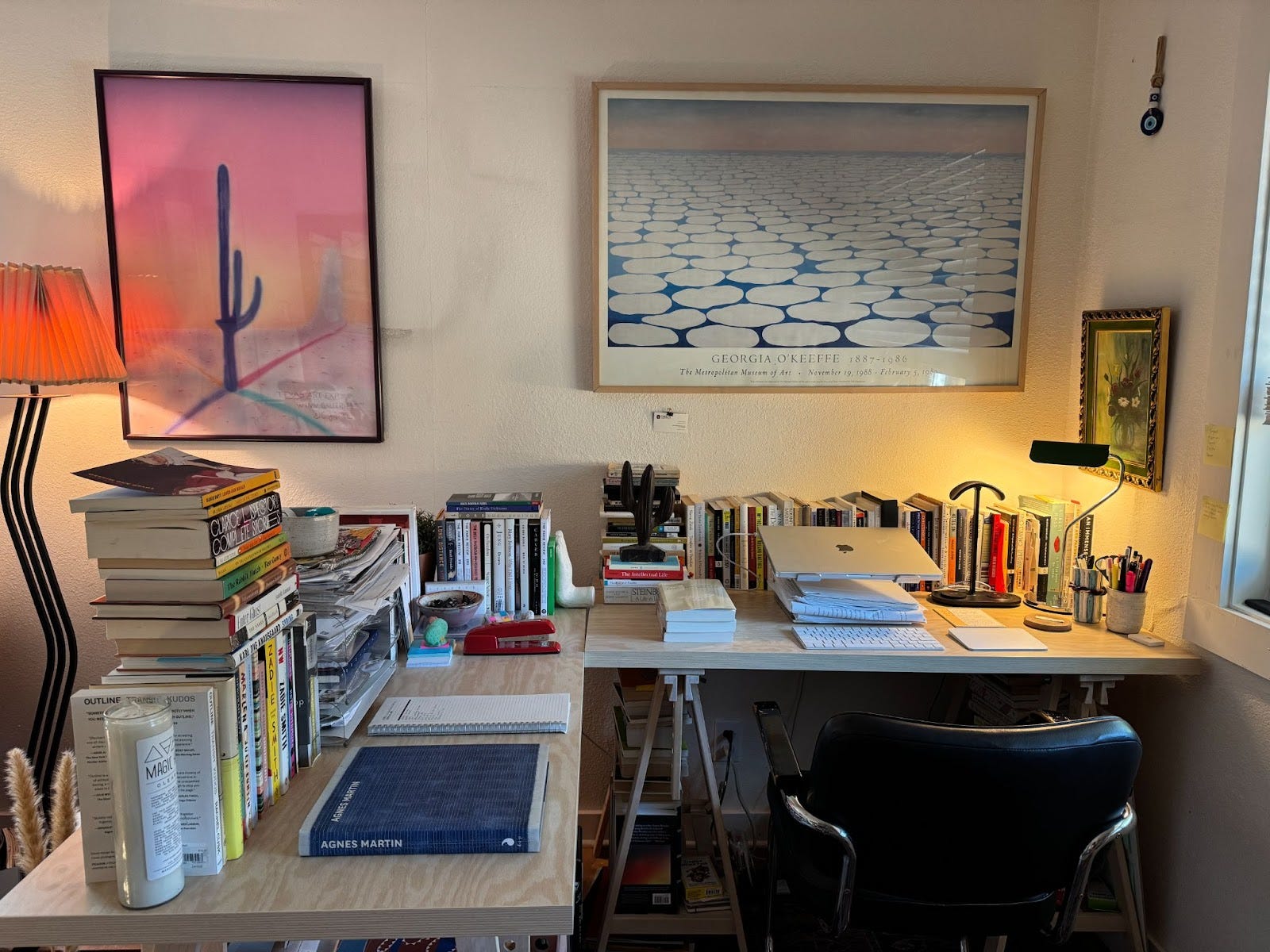
On an average week, how much do you read and when?
I read every single day, without exception. It could be brief, an essay or short story or article here or there, or more substantial, a few hours in a chair. I also read for thirty minutes or an hour before bed and, usually, in the mornings as well. In so many ways, I feel like I’m trying to make up for the unfocused way I read in my twenties and is no doubt informed by the fact that I’m trying to be a writer. I want to stress that changing my habits wasn’t natural or easy, even though, as I mentioned, I have considered myself a reader my entire life. I have had to train my brain to think of picking up a book or magazine instead of my phone and sometimes, maybe even often, I fail. I tend to think of reading, and writing, as a lifelong practice, like yoga. It’s one of those things that you refine over time. It’s one of those things that ebbs and flows. But, the important thing about it is that it remains constant, an ambient hum throughout a lifetime.
PKG: As a former yoga and meditation teacher, I fully support this message. We are only human, after all, life knocks us off our feet all the time… but it is important to maintain a steady practice that nourishes you, be it yoga, reading or something else. When you find your mind start to wonder, just return to the thing that keeps you centered and begin again.
What do you like to read? How has your taste changed over the years?
I read mostly fiction and poetry, though I’ve been gravitating back toward essays and non-fiction, mostly in buying habits and not yet reading habits, though I hope to change that over the next few months. When I was working in news in New York, I read 50/50 nonfiction and fiction, maybe even more non-fiction, and now I’m probably… 90% fiction/poetry.
My taste has changed as my ambition for my life has changed. Over the last, say, eight years or so I’ve been pushing toward becoming a better writer, so I’ve pushed myself to read more, read better, read closely, read with intention. I don’t have any formula for this and try to trust my intuition on what that means. Often it means reading books that writers I love and admire have recommended or talk about often. I was just at a writers conference and someone was talking about taste and imitation and said that, as a writer, you shouldn’t imitate Raymond Carver, because he was imitating Chekov. If you imitate Chekhov, your writing could become brothers with Carver, rather than a son.
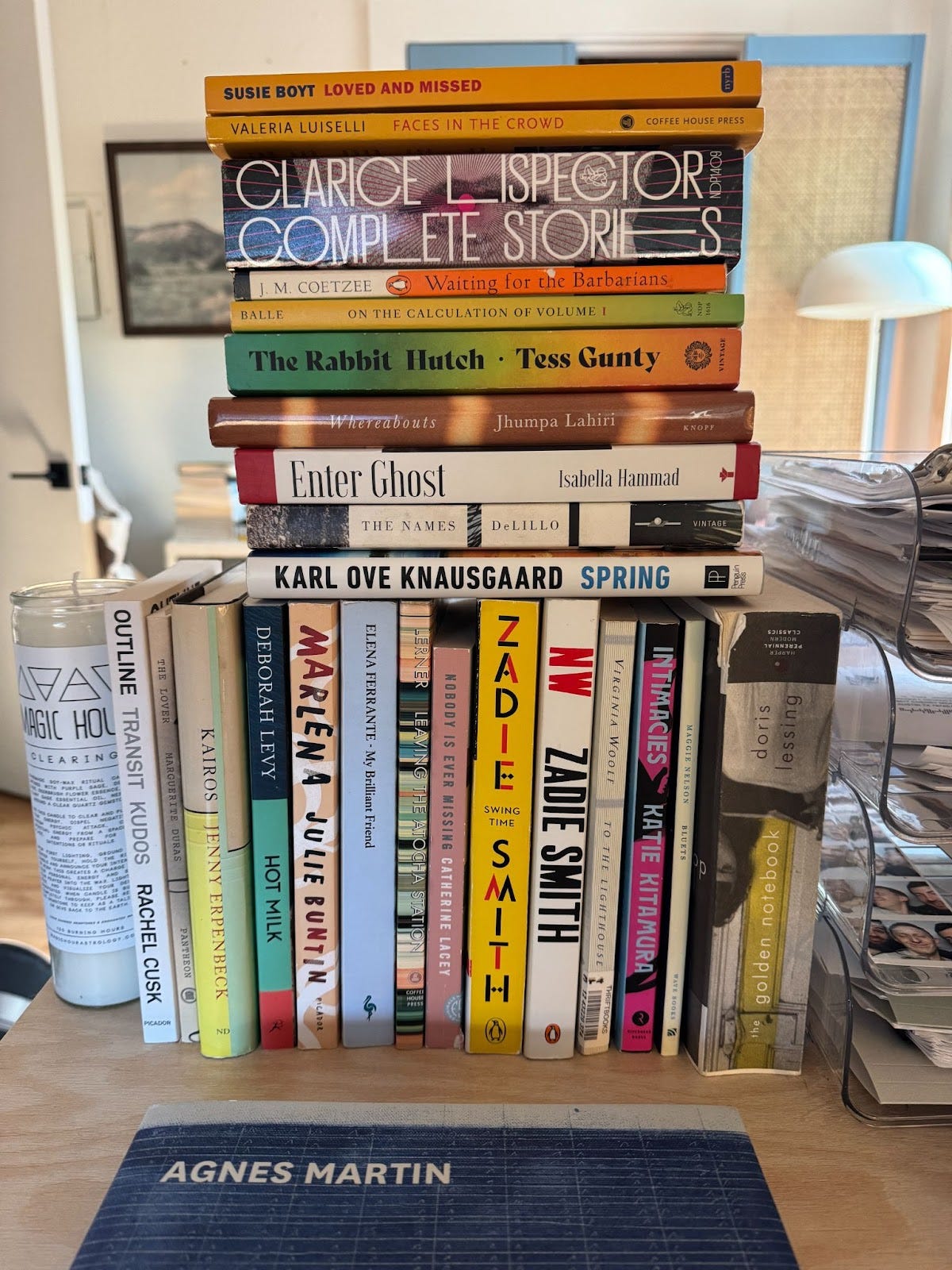
I’ve been treating writing like that. How can I dig deeper and deeper underneath the writers that I love? So, I’ve been trying to read like that. An example is that in an interview somewhere Zadie Smith said that reading Middlemarch was a transformative experience for her, so I read Middlemarch, and that reading then cast a new light on everything of Zadie’s I’d read. It’s so special, to keep the conversations in your head going with writers long after you’ve finished their books.
A few books I’ve read and loved recently:
Fiction: Loved & Missed by Susie Boyt, Kairos by Jenny Erpenbeck, Women in Love by DH Lawrence, Memoirs of a Dutiful Daughter by Simone de Beauvoir, Enter Ghost by Isabella Hammad.
Poetry: Helen of Troy, 1993 by Maria Zoccola, With My Back to the World by Victoria Chang. I also recently saw Paisley Rekdal read some of her poems and it changed my life.
PKG: Be sure to click on that Paisley Rekdal link above. You must.
What's a reading ritual or habit you've developed that's unique to you?
I don’t know if this is unique to me, though I don’t personally know anyone else who does it, but I try to track all of the short stories I’ve read in a spreadsheet called “short story/essay a day.” I’ve been doing this for three years and I want to be clear that I’ve never met that goal, but I love having the ambition of it and love going back and seeing what I’ve read and what I thought. I try to flag the ones that really stuck with me, like Lauren Groff’s Between the Shadow and the Soul and Ira and the Whale by Rachel B. Glaser. I think having a structure, even a light one, is nice for me. It allows me to see myself in a new way, through the stories I’ve read and loved. I can go back and look at them as both a reader and a writer, too, by further narrowing in on what my tastes are, how they are changing, and by being surprised by loving something I probably wouldn’t have thought.
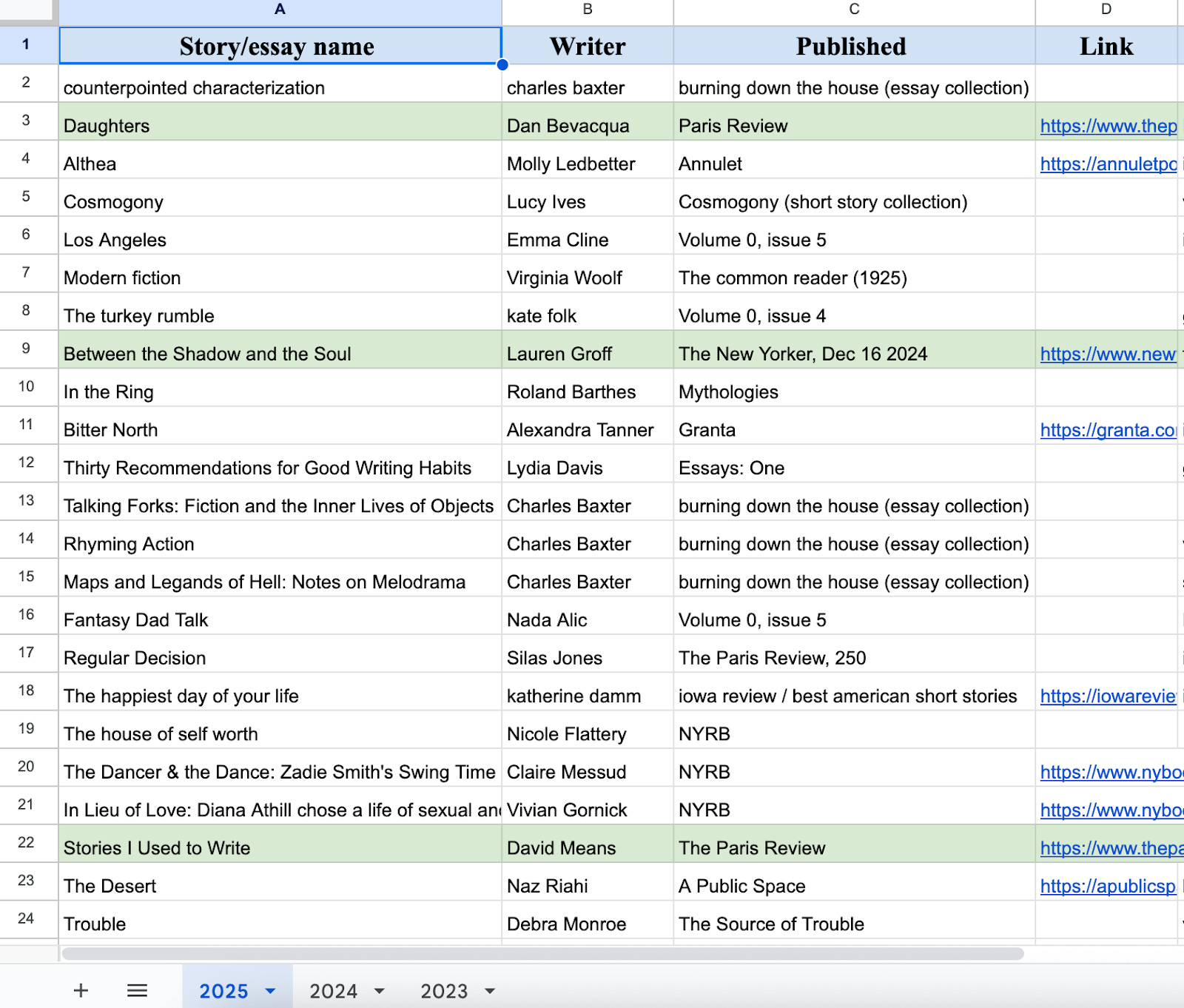
PKG: I love a great archiving project. This is a fantastic way to let your reading data speak back to you about what you like and gravitate towards.
Do you take notes while you read? If yes, are you particular about your materials - notebooks, pens, highlighters vs. pencils, etc?
Yes! Over the last year, I drew courage from one of Garth Greenwell’s posts about taking notes and started to furiously underlining and annotate my books, though I’m mostly just underlining. It’s hard to believe I’d been a reader for so long without doing this. I love, love, love being able to go back and see what resonated with me. I will go back and type up all of the sentences and paragraphs I love in a massive document I have titled “GOOD SENTENCES AND PARAGRAPHS” that is wildly, wildly long and I’m sure I’ll need to start a new one at some point. I suppose that I mostly re-type things from fiction, but I will write by hand poems I love. I’m not really sure why I do these differently, but that’s the way it works for me. I think I want to slow down with poetry and physically feel the poem, feel every word, and with fiction I’m trying to sense a particular rhythm, since I write using my computer and not by hand. I have a big stack of books that I’ve already ready that are waiting to be typed into the document and I’ve taken my time doing it. It’s nice to revisit books this way, even months later. The experience reminds me of getting photographs developed — you get to re-live the moments well after they’ve happened. Maybe I’m subconsciously finding ways to slow my brain down and give myself time to process what I’ve read. Or it’s just ADHD.
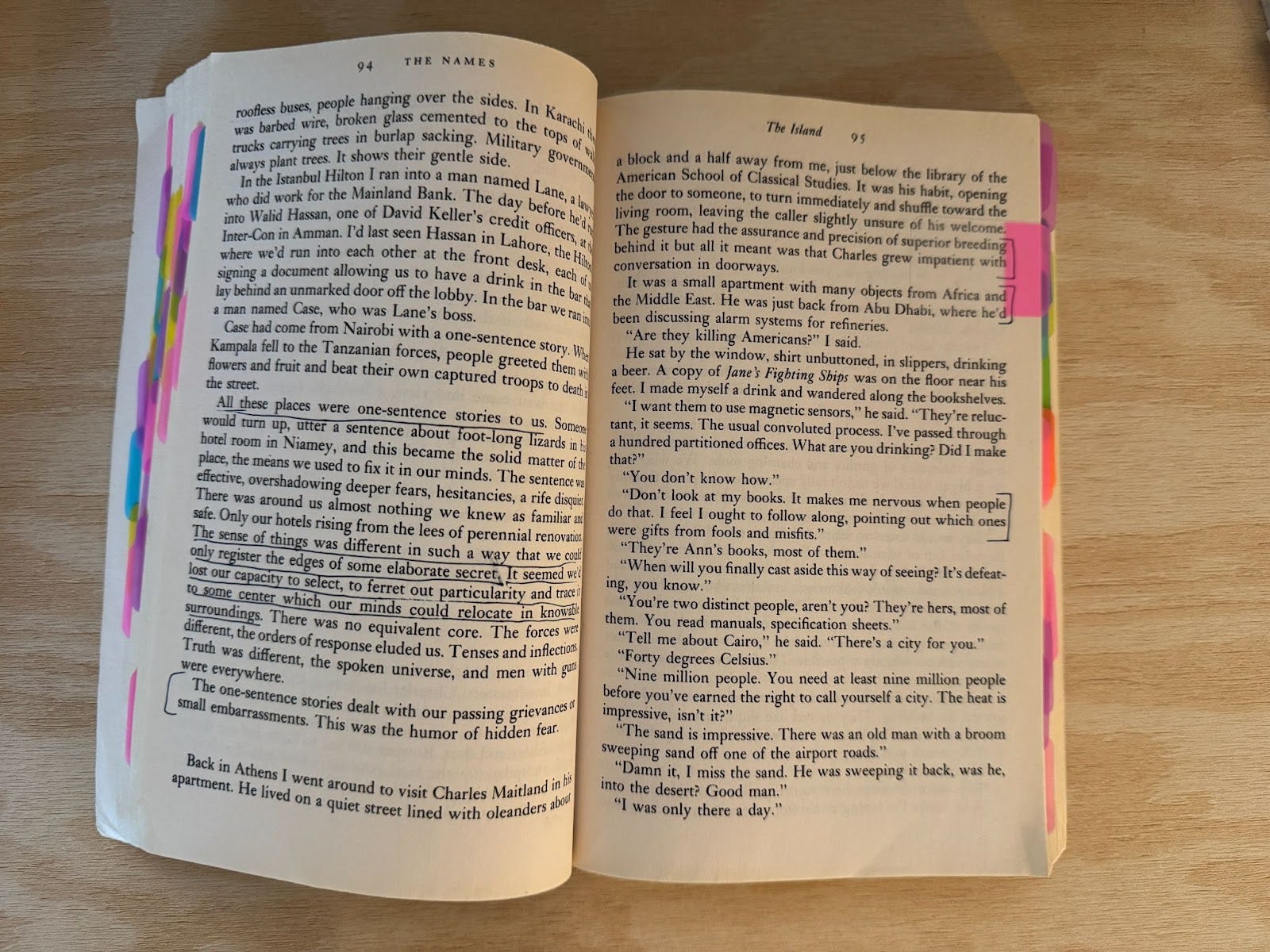
When it comes to materials, I have two types of pens that I find acceptable. The OHTO Rays gel ink pen in .5mm and the Muji pens, in both .5mm and .38mm. I think I prefer the .38mm but I have a bunch of .5mm ones, so I use them.
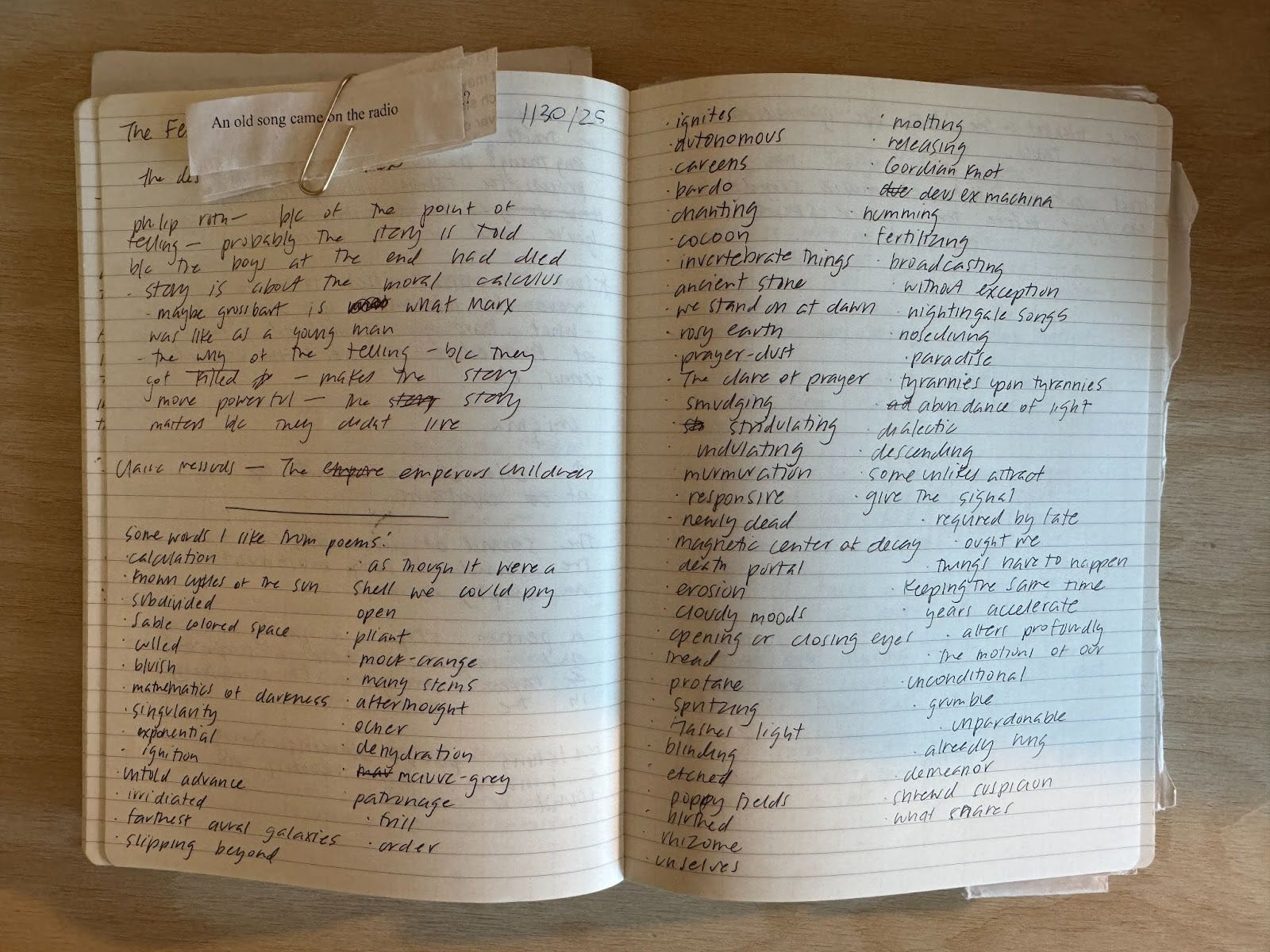
There’s a really lovely store in Austin called Take Heart that stocks a bunch of beautiful, beautiful things, from ceramics to teas to skincare, and they have a nice stock of Japanese notebooks that I often buy when I’m there, so I always have some on hand. I probably have…ten or fifteen empty notebooks that are waiting for me. I’ve reined in this habit, but there is a long tail to going through accumulation.
How do you keep track of what you want to read? How do you decide what to read next?
I have a system in my mind that makes sense to no one, not even me. There are various piles throughout my house and when I need a new book, I will spend time with each pile and see what speaks to me. None of the piles have a particular theme. They usually end up together based on some kind of gathering mania that I’ll go through, but why they end up together is for my subconscious alone to know. I have a few different piles in my office, around my desk, I have a “to read” shelf on the bookcase in my office and there’s another one on the bookcase in the living room. I usually have a few books sitting at my bedside as well. I like to tell people that reading and buying books are two different hobbies. I am an enthusiast of both.
Usually, when I’m spending my time in the piles, I’ll look for something that pertains to what I’m preoccupied with. For example, I’ve been thinking a lot about female friendship over the last year or so, so I’ve gravitated toward books that relate to that, even obliquely. I think I have a few distinct things I’ll pick a next book for. Sometimes I’ll choose it based on the subject matter, like female friendship. Sometimes I’ll choose a book because of the structure, if I feel like reading a book that is doing something interesting with craft. Sometimes I’ll choose a book because I want to be soothed. Sometimes I’ll choose a book because I want to be held. And sometimes I’ll choose a book because someone I dearly love tells me I should read it. Choosing a book to read next is a mysterious art.
Where do you get ideas about what to read?
The most common way is seeing what other writers are reading. To me, that is a sort-of filtering process. If a writer I love likes a book, then, chances are, I’ll like it, too. A few months ago, the writer Isabella Hammad was visiting Texas State University (where I did my MFA), and mentioned offhand that she’d liked Loved & Missed by Susie Boyt, so that’s what led me to that book, and, thank god, because I loved that book so much. It wrecked me! In a way a book hasn’t wrecked me since I was maybe a teenager! It felt so luxurious to be wrecked like that. But, similar to deciding what to read next, there are so many different ways. I love going to bookstores. In Austin, we’ve got Alienated Majesty, First Light, and BookPeople, and there is good, and different, curation going on at each. When I’m in other cities, I always go to bookstores, so I can see what those booksellers are recommending, too. I would trust a bookseller with my life, I think. There are times when I’m very purposeful about finding books, like when I’m interested in a particular topic or theme or craft-thing.
How do you decide what to read next? Are you a mood-reader or a planner?
I answered this a little, but I’ll say it’s closer to mood than planning, though, if I’m being honest, it’s probably an excited mania, like a child going to bed before Christmas. Choosing a book to read is the most exciting thing to me. There is so much promise. There is always a chance that the next book you read will change your life completely. I love that so much.
But, I also love the prompts you do every week! Even when I’m not answering them in the thread, I’m often answering it for myself in my mind.
When people ask me how come I read as much as I do, I frequently just give them a list of things that I don’t do as regularly as I probably should: exercise, clean house, spend time with friends. What do you choose NOT to do in favour of reading?
I really don’t watch TV at all. That habit didn’t really happen on purpose either. In New York, I didn’t have a TV, because I never lived in an apartment that would fit one. So, when I moved back to Austin, I didn’t have a TV and we didn’t get one until last year, I think. Since I went so long without a TV, I lost the habit, and I’ve just never been able to get back into it. Occasionally I’ll dip into the modern era and watch a show (like Succession), but it’s not a part of my life. Actually, no, there is one exception to that. I am extremely devoted to The Great British Baking Show. And I loved season one of Last of Us, but I thought season two was only okay.
Early on in COVID, my partner and I made a rule that phones were not allowed in our bedroom at night. So, that also created space for reading every night. I was reading most nights anyway, but this really solidified that block of time before bed for reading. I’m a bulk cleaner (I clean less often, but for five or six hours at a time), so I’m sure that gives me some time, too.
I also try to read in those in-between moments. On planes, on buses, waiting for a friend to arrive at a wine bar. Maybe it’s only a few pages, but that’s enough.
Do you have any tips or advice for people who wish they were reading more?
Find ways to stop looking at screens. Delete Instagram, delete TikTok, resist the urge to watch some zeitgeist-y television show. Embrace being outside of the trend cycle.
I also think it might be useful to find a few people, even just one other person who has similar taste as you, that you can read with. Reading is a solitary experience, but adding a social element to it can deepen your connection to a particular book, or even the act of reading itself. I love hearing what others think about books — what they saw or took away that I didn’t. The Center for Fiction has amazing programming and they just released a bunch of reading groups. Some are in-person in Brooklyn, but many are online, including a nearly year-long class on Joyce’s Ulysses. A Public Space, an incredible literary magazine, also has an online-only book club through Substack. The New York Review of Books will also host seminars on books and you can email them to get recordings from past seminars, which I did for Merve Emre’s seminar on Middlemarch. Garth Greenwell and Catherine Lacey also host book clubs through their Substacks.
I also think it’s useful to find books that can help you get into (or back into) the habit of reading. That looks different for everyone, but for me it means reading books that are a little bit more tension-forward, so they move faster. Audition by Katie Kitamura did this for me recently.
The last thing is to embrace books that are “hard” to read! Embrace friction in life! When I read Ulysses in school, it was hard. There were parts of it that were unbelievably dense. But, when I finished it and could appreciate the parts as a whole, the experience was so worth it. I think this holds true for a lot of philosophy, criticism, and non-fiction as well. In his book Change, Édouard Louis writes about this:
I read, but I didn’t understand what I was reading, the sentences were too complex, the books referred to notions and concepts I was unfamiliar with and couldn’t grasp. I kept at it, telling myself that I’d understand later after I’d finished reading, that keep book would give me the keys I needed to understand the one I’d read the day before, I tried to persuade myself that if I understood one page in fifty I’d already have accomplished a lot—I couldn’t always convince myself—or lie to myself—and some some evenings I’d get discouraged by the pages of an open book, unable to decipher a simple succession of letters of words, I hated myself, I despised myself, I’ll never make it. I labored to find a way into books that resisted, as if the sentences were physically pushing me away. I suffered for being myself. But I kept reading…[and] after several weeks I started having a better grasp…the fits and tears became less and less frequent…I was experiencing the first results of my work and effort.
I think reading, and reading hard, is the best way to spend one’s time.
What is one book that you find yourself recommending to people over and over and over again?
This list is by no means comprehensive and I’m sure by the time this interview comes out, I’ll be kicking myself for not including this or that book on the list, but there are a few that came to mind right away:
Fiction: Lonesome Dove by Larry McMurtry. Waiting for the Barbarians by J.M. Coetzee. Sula by Toni Morrison. Dancer from the Dance by Andrew Holleran. The Details by Ia Genberg. The Bee Sting by Paul Murray. The Idiot by Elif Batuman. East of Eden by John Steinbeck.
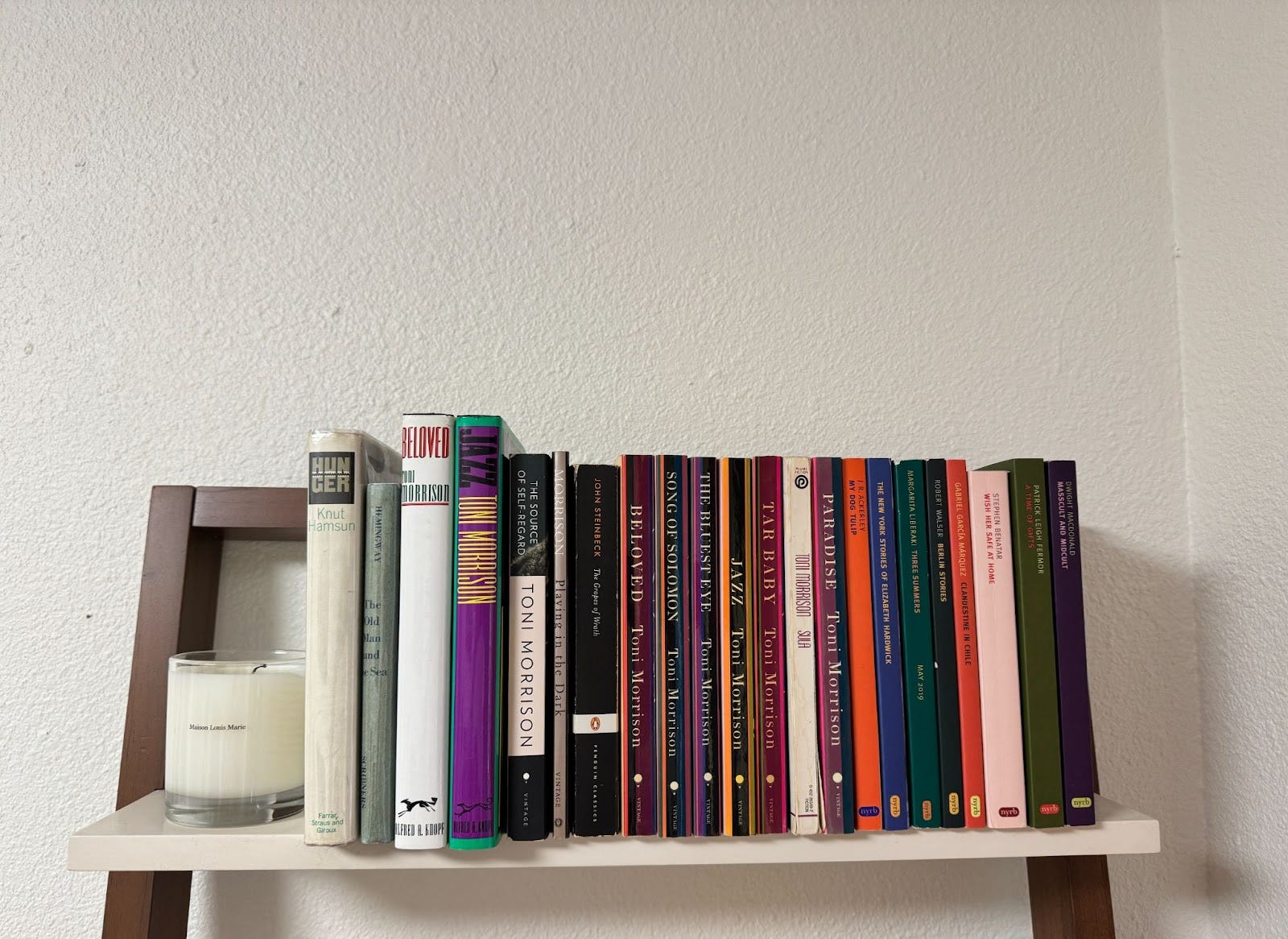
Poetry: Morning Poems by Robert Bly. Wallace Steven’s Collected Poems. Citizen by Claudia Rankine. Strike Sparks by Sharon Olds. Love, An Index by Rebecca Lindenberg. Is There Room for Another Horse on Your Horse Ranch? By Cyrus Cassells. Helen of Troy, 1993 by Maria Zoccola. Ararat by Louise Glück. Girls That Never Die by Safia Elhillo.
Non-Fiction/Essays/Philosophy/Criticism: How to Write an Autobiographical Novel by Alexander Chee. Robert Caro’s LBJ books. On Freedom by Maggie Nelson. A Lover’s Discourse by Roland Barthes. Eros: The Bittersweet by Anne Carson. Seeing Is Forgetting the Name of the Thing One Sees (Conversations with Robert Irwin) by Lawrence Weschler. The Unreality of Memory by Elisa Gabbert.
I cannot overstate enough how much I love to talk about books. Books are my life’s greatest joy.

As soon as I hit publish, I plan to disappear into Jacqui’s Spotify Playlists but in the meantime…
🤓 I have some questions for you guys:
Which of Jacqui’s tips and ideas resonate the most with you?
Do you remember a particular childhood reading ritual that shaped the kind of reader you are now?
Jacqui keeps a spreadsheet of the short stories she reads — do you have any quirky systems or habits for tracking your reading (or your life)?
Thank you, Jacqui. And I love these approaches to a deliberate reading practice, they’re making me think I at least need some kind of reading diary. Something I’ve never had.
Tattooing "Embrace being outside of the trend cycle" on my forehead!