


In early August I did a 2025 Reading Goals check-in and in the spirit of honoring the promises I make to myself, I pulled a couple of piles of books that I hope(d) to finish before the end of the year. The piles are all over the place but mostly involve books I’ve been saying I want to read for too long and I was starting to feel tired of hearing myself say ooh, that’s on my TBR. So, at the beginning of September, I pulled some titles from those TBR piles without a theme in mind. Just things that sounded good. When I looked at the stack, I realized that most of them were pretty short and I thought how cute it would be to do a September of Shorts. The internet loves A THING.
I am on the record for praising short books — especially as an antidote to endless scrolling. A short book is the opposite of that. If the endless scroll gives you no beginning, no end and amorphousness… a short book gives you a clear beginning and end, all within reach — a completed thought that you can wrap your mind around. September was shaping up to be a busy time at work… so I thought this would be perfect. I thought I could dip in and out, and still get that strong dopamine hit that you only get from reading the last sentence of a good work of fiction. Some of the authors I selected were new to me but some were tried and true favorites. To say that my expectations were high would be a gross understatement.
The resulting month was a bit of a let-down… and in a way that felt surprising to me. I enjoyed every single book I read on its own but the overall reading experience of my September was utterly disappointing and decidedly unenjoyable. As I mentioned in my September favorites video — it was a frazzling month —and I think that the quick clip at which I was reading only added to the general sense of nervousness and unease I felt. What the heck?! I could feel this pretty early on into the month but because I had committed to A THING… I kept going… only to feel more and more spiraling, more and more frazzle. It was not a good feeling.
.Thankfully, somewhere mid-month, something possessed me and I picked up Anna Karenina back again. I had started the communal read-along with Henry Eliot earlier this year and had loved the first few sections I read but then got off schedule and decided to set it aside for a better time. Thank God for that… because this sprawling story of love, lust and politics was the exact antidote for the hurt my September of Shorts was causing me. Reading Annie K. slowed times down and transported me to a time that felt so distant and removed from my current reality while also feeling emotionally so resonant that I felt giddy reading it. I started cheating on my concept project and sneaking little reading sessions at night. There is nothing I love more than being so intoxicated by a book that I feel like I am cheating on other authors (and my life) by reading it.

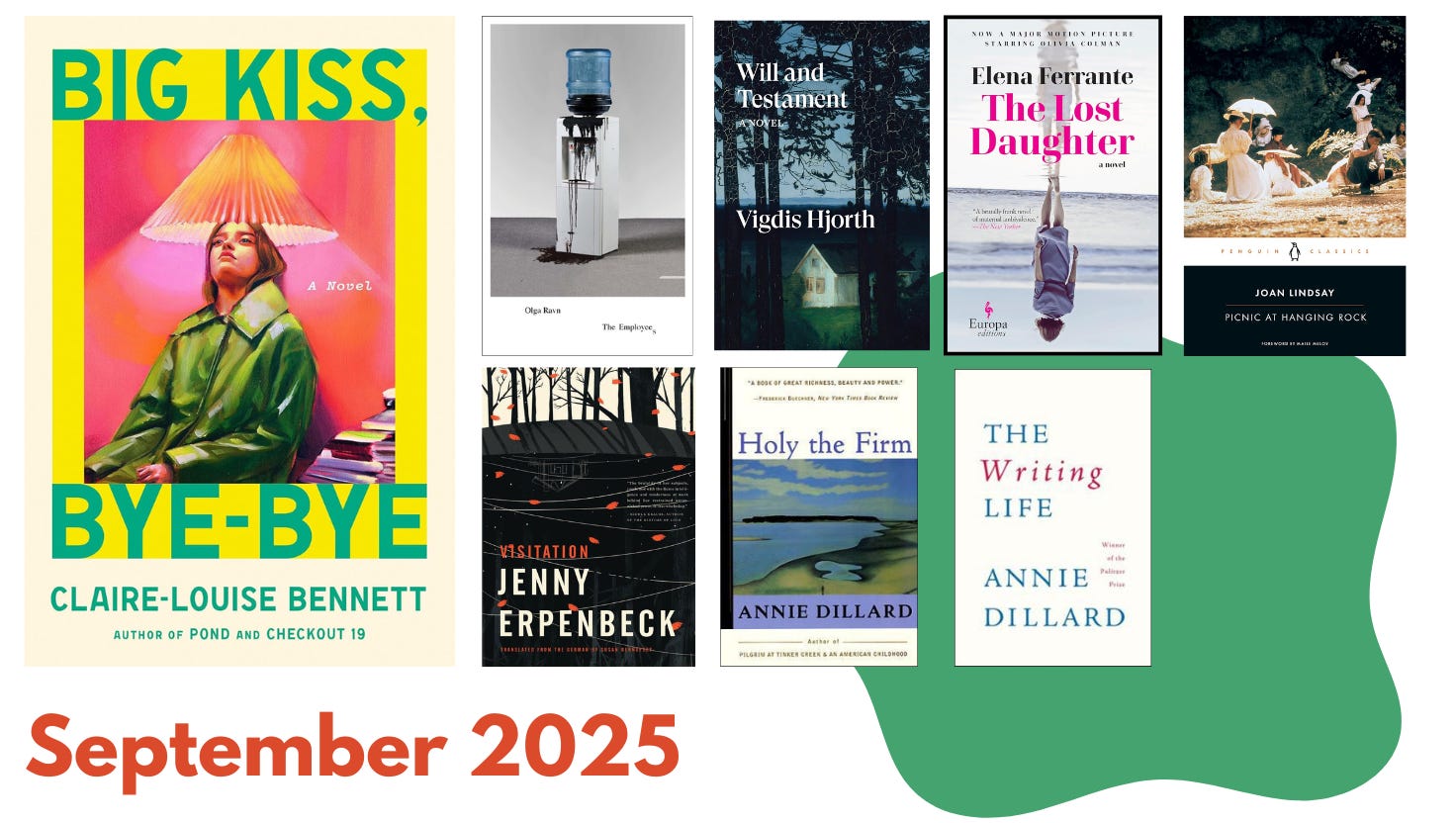
📚 Books mentioned:
The Employees — Olga Ravn
Will and Testament — Vigdis Hjorth
Holy the Firm — Annie Dillard
Picnic at Hanging Rock — Joan Lindsay
Visitation — Jenny Erpenbeck
The Writing Life — Annie Dillard
The Lost Daughter — Elena Ferrante
Big-kiss, bye-bye — Claire-Louise Bennett

📚 The Employees — Olga Ravn
As someone who actively considers myself NOT a science fiction fan, I must admit that some of my most favorite books in recent memory have been dystopian and sci-fi adjacent narratives. The Employees is now one of them.
On board a spaceship in the 22nd century, a crew is divided between human and humanoid workers designed to assist them. When the ship retrieves a set of strange and beautiful objects from a newly discovered planet, everything changes. The objects radiate an uncanny pull, awakening feelings of longing and disorientation in both workers and humans. Through a series of brief testimonies, complaints, and reports, the novel reveals how labor and identity become unsettled in the presence of beauty and desire. Ravn’s fragmented and poetic narrative refuses to give easy answers but instead opens up space for questions about what makes us human, how we experience love, and whether devotion to work can ever replace devotion to life itself.

The mysterious objects in the novel were directly inspired by the sculptural installations of Danish artist Lea Guldditte Hestelund. Ravn wrote the novel as a companion piece to Hestelund’s exhibition, and she and Hestelund collaborated, with Hestelund’s works providing a basis for the book’s iconic “not really human, but still living” objects.
In the beginning Lea would show me sculptures, or work that was underway, and I would try to write little testimonies, statements about them. But then, pretty fast, I started to write about sculptures she hadn’t done. It was an agreement between us that she wanted me to write a text about a sculpture, but then add something that wasn’t there. I started writing all kinds of stuff and then began to build a world; the ship and the employees. I would email these texts to Lea as I was writing them and she would write back saying it reminds me of this and this. She would then make sculptures inspired by the writing. It was a very fruitful partnership. Lea took me to meet a perfumer because she wanted a perfume for her exhibition. We are both interested in the other senses, not just sight.
I didn’t research the sculptures until after reading the book and was quite shocked at how intense their presence in the novel felt. Digging into the collaboration between Lea and Olga, I got curious about other books which center art pieces. The two that came up for me off the top of my head were The Goldfinch by Donna Tartt and A Little Life by Hanya Yanagihara. If there are art history nerds among us, I would love to hear your recommendations for your favorite books that prominently feature art or artists that you think give a good look into the interiority of artists — real or imagined — and provide compelling descriptions of artwork that does not read as basic, boring or contrived. I know that I can google it (and I will) but I prefer real human recommendations! Thank you in advance.
📚 Will and Testament — Vigdis Hjorth
Content note: childhood sexual abuse.
Because getting wracked by A Girl’s Story and Sad Tiger last month was not enough, somehow I thought it would be a good idea to read another story of the magnitude of human darkness, the deep secrets kept by families for ages, about the fact that for many women… the biggest suffering, humiliation and destruction of spirit comes at the hands of family members.
When her father dies, Bergljot refuses the inheritance she is entitled to, setting off a family drama that at first looks like a financial dispute over real estate but slowly reveals itself to be rooted in darker truths from her childhood. The novel unfolds as Bergljot reckons with the abuse she suffered, the silence that protected it, and the corrosive loyalty that kept her siblings on the side of denial. Hjorth writes in a style that is confessional and urgent, moving between present conversations and the protagonist’s disturbing memories.
The book examines how trauma lodges itself in families, how narratives of the past fracture, and how speaking the truth can both liberate and isolate. I know that Vigdis Hjorth is fairly well known but this was my first book by her and I found the writing absolutely piercing and the exploration of what happens when one person insists on confronting what others cannot bear to see was just impossible to put down.
As soon as I finished, I purchased Is Mother Dead and If Only. I hope to get to them very soon.
📚 Holy the Firm — Annie Dillard
First Annie Dillard for me after seeing a beautiful write-up about it on Eve’s Substack. This book was written during a period of seclusion on an island in Puget Sound as Annie Dillard attempts to return to writing. The book begins with elemental descriptions of the natural world around her — clouds, moths, spiders hiding behind the toilet, the changing light of morning sun — and then turns toward a local accident that burns a young girl’s face.
The horror of this event brings into sharp relief the central questions that hover throughout: why beauty exists alongside pain, what it means to believe in a God who allows tragedy, and whether art or language can hold these contradictions. The text is brief, but it carries the density of both poetry and prayer. Dillard compresses theology, philosophy and lyrical observation into a meditation that confronts the limits of human understanding and the possibility of divine presence in even the most devastating moments.
I was in a group chat with Eve Matheson and Regan this month as we read Annie Dillard’s The Writing Life as well… and we all agreed that Dillard is deceptively gentle. Her writing is so beautiful and lyrical but it feels like a kick to the teeth at times. I don’t know what I was expecting but I found the writing style quite challenging in the way that poetry often feels to me. In this book as in The Writing Life every word counts and I felt exhausted after reading them. It took all my processing power to get through them and I do believe that both these books require a re-read.
📚 The Writing Life — Annie Dillard
The Writing Life is Annie Dillard’s meditation on the nature of writing as a vocation. Rather than offering technical instruction, she circles around the experience of creation with anecdotes, metaphors, and reflections that illuminate the discipline and intensity required of a writer.
She describes the writer’s solitude, the long hours of work that can lead to sudden moments of breakthrough, the difficulty of cutting beloved passages, and the exhilaration of sentences coming alive on the page. Dillard likens writing to building a house, flying a plane, and even to physical combat, drawing parallels that capture the bodily and emotional demands of artistic labor. Though it acknowledges the frustrations and sacrifices, the book also communicates the joy and necessity of writing, insisting on its place as a calling rather than a hobby. The Writing Life is both practical and philosophical, a text that speaks directly to anyone who has tried to wrestle with language and meaning.
The book is also a love letter to reading… because what is writing than a devotion to what one has read and felt moved by in the past:
Why are we reading, if not in hope of beauty laid bare, life heightened and its deepest mystery probed? Can the writer isolate and vivify all in experience that most deeply engages our intellects and our hearts? Can the writer renew our hope for literary forms? Why are we reading if not in hope that the writer will magnify and dramatize our days, will illuminate and inspire us with wisdom, courage, and the possibility of meaningfulness, and will press upon our minds the deepest mysteries, so that we may feel again their majesty and power? What do we ever know that is higher than that power which, from time to time, seizes our lives, and reveals us startlingly to ourselves as creatures set down here bewildered? Why does death so catch us by surprise, and why love? We still and always want waking.
He is careful of what he reads, Dillard warns, for that is what he will write. He is careful of what he learns, for that is what he will know.
On a practical note, if like me you are in the middle of a writing project of your own, I highly recommend reading this. Our group chat agreed that this book is very much a tough-love kind of read — no coddling, no go easy on yourself, hon —but at the same time, extremely pragmatic and liberating. I have a completed first draft of a novel and huh-ing and hmm-ing about where to begin with my first revision — and this little volume basically told me, just get over yourself… read what you have, cut most of it out and write like you are writing for a dying person… What could you say to a dying person that would not enrage by its triviality?
📚 Picnic at Hanging Rock — Joan Lindsay
At some point in the month I had a craving for a plot driven story that is still inconclusive. I went through my TBR journal and discovered a note I wrote to myself a while back to read Picnic at Hanging Rock. This was based on a post by Kate Jones. I knew little of the story but I remember thinking at the time that the book sounded fascinating, I really love stories that explore the dark side of girlhood.
On a hot Valentine’s Day in 1900, students from a boarding school for girls set out on an excursion to the strange geological formation known as Hanging Rock. The outing is meant to be a leisurely picnic, but when several girls and one teacher vanish into the rocky landscape, the school’s community is shaken to its core. Search parties are launched, rumors spread, and the headmistress of the school faces scandal, yet no satisfactory explanation emerges.
Lindsay’s novel lingers in the mystery, refusing to provide closure, which I absolutely LOVE as frustrating as it feels at the time. Instead it explores the unsettling power of the Australian landscape, the repressed desires of the girls and their caretakers, and the thin boundary between civilization and wildness. Both gothic and dreamlike, the book is as much about the silences and absences as it is about the events themselves, creating a haunting atmosphere.
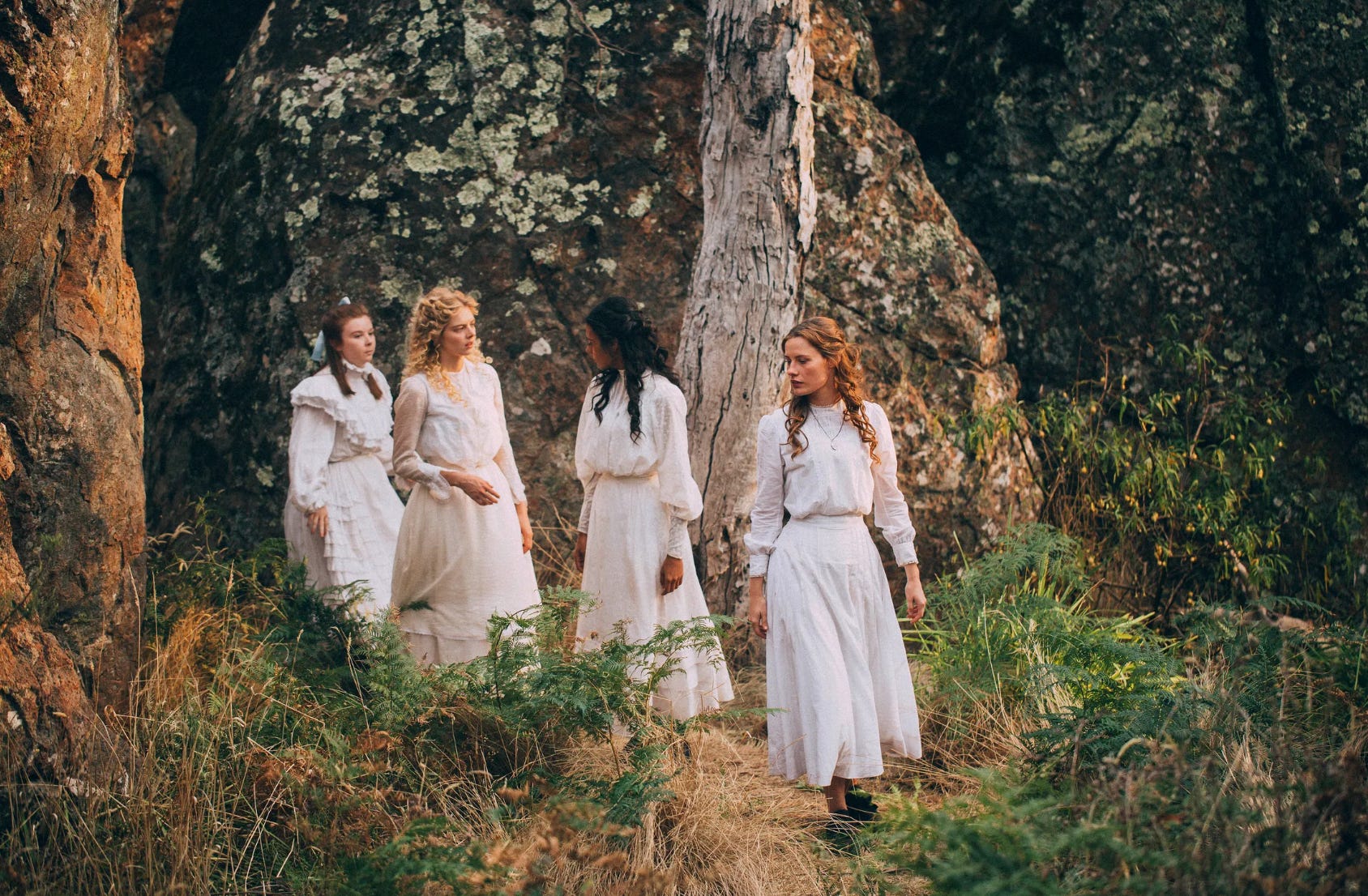
It really reminded me of The Virgin Suicides by Jeffrey Eugenides and Kate agreed that this book gives you the same sense of dread. I hope to see the film and/or the mini series soon, too. The book feels very cinematic.
📚 Visitation — Jenny Erpenbeck
After reading and obsessing over Kairos by Jenny Erpenbeck, I knew I had to make my way through her oeuvre quickly. Visitation is Regan’s favorite Erpenbeck, so naturally I picked it up.
The novel is organized around the lifespan of a house on the shore of a Brandenburg lake. Over the course of the 20th century, different families and individuals pass through its rooms, each marked by the historical upheavals of Germany. A Jewish family must flee during the rise of Nazism, their property confiscated. Later, the house is occupied under East German rule, its residents constrained by bureaucracy and surveillance. The house endures while the lives of its inhabitants flicker and vanish, a silent witness to displacement, loss, and the passage of time. Erpenbeck writes in spare, luminous prose, weaving fragments that suggest both the permanence of place and the fragility of human existence. The novel is at once intimate and sweeping, a story about ordinary lives intersecting with history and about the way memory adheres to walls, gardens, and the land itself.
Reading it brought back for me the years just after the fall of communism in Bulgaria, when families were given back land that had been nationalized and collectivized decades earlier. I remember my usually stoic grandfather moved to tears as he showed us a plot that had belonged to his family before it was taken in the 1940s. The house was gone, but the plum orchard remained. Erpenbeck’s writing — both clinical and deeply moving — echoed his own meticulous recalling of where the house had stood, where the animals were kept, which bed belonged to whom, and who the neighbors were, before one night it was all gone, packed up while his father was away.
For anyone who’s read the book: the sections with the architect’s wife and the Red Army soldier absolutely gutted me.
📚 The Lost Daughter — Elena Ferrante
Ferrante mania continues. I am one book away from completing all of her novels and The Lost Daughter may be my favorite so far. Definitely my favorite of the stand-alone novels I’ve read by her.
Leda, a middle-aged professor on holiday at a beach resort in southern Italy, finds herself transfixed by a young mother and daughter she observes each day. Their closeness stirs up memories of her own past, particularly her conflicted feelings about motherhood and the choices she made that separated her from her children for a period of time. When Leda impulsively steals the daughter’s beloved doll, a chain of encounters unfolds that forces her to confront her own desires, guilt, insecurities and longings.
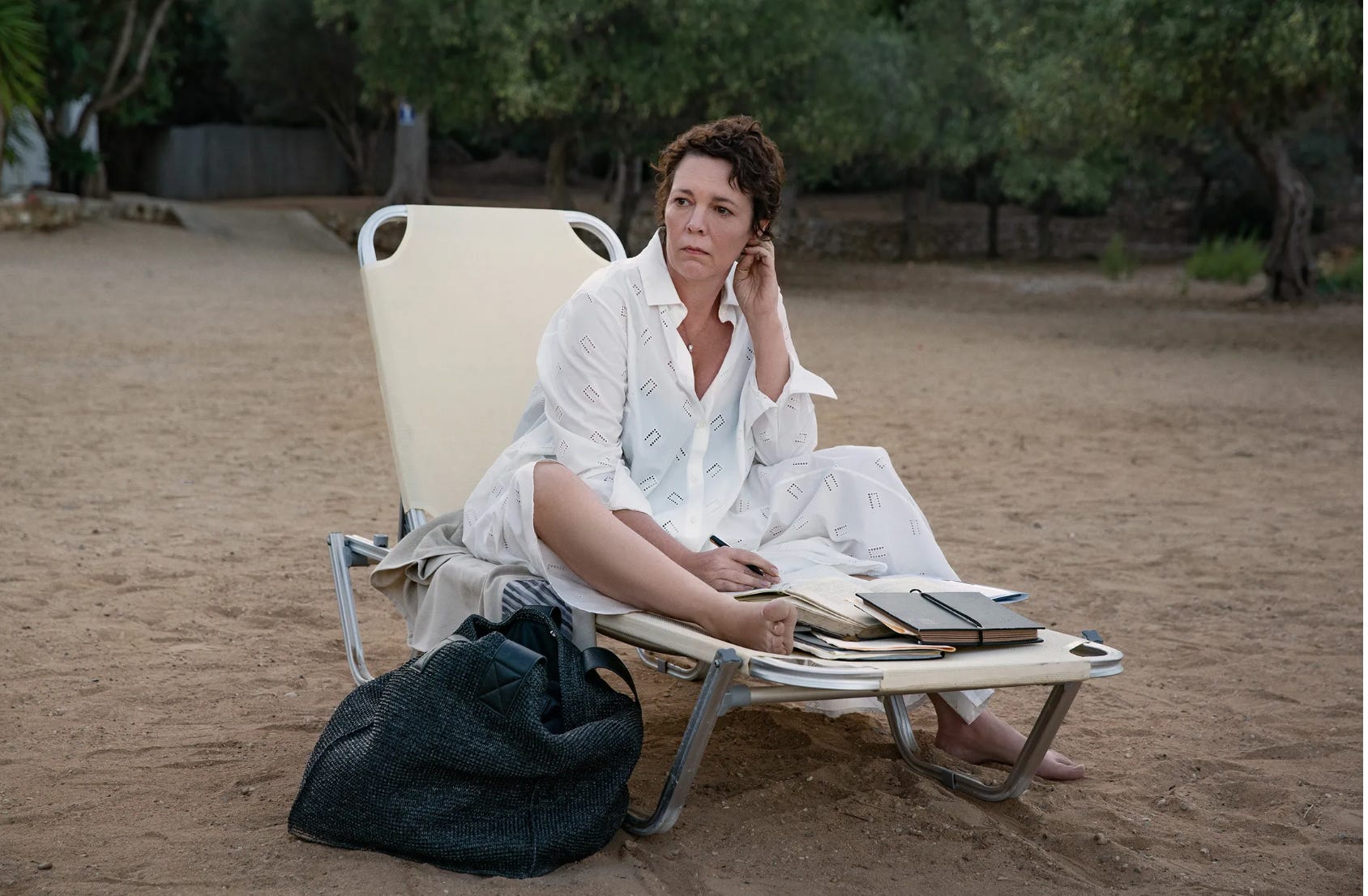
The novel is taut and unsettling, suffused with Ferrante’s gift for capturing the contradictory inner lives of mature women. Themes of maternal ambivalence, freedom, and shame ripple through the narrative, which becomes as much a confession as a story. The Lost Daughter is a compact but piercing examination of how the roles assigned to women collide with their hunger for autonomy and selfhood… I am curious if Ferrante fans will agree with me but in a way, this story felt like the abridged version of the Lenu storyline from The Neapolitan Quartet.
If you are curious about Ferrante but can’t yet commit to the Quartet, I recommend you start with this one. And, I must mention that there is a film adaptation that was directed by Maggie Gyllenhaal starring Olivia Colman, Jessie Buckley, Dakota Johnson and Paul Mescal that looks amazing.
📚 Big-kiss, bye-bye — Claire-Louise Bennett
My favorite book of the month was the soon-to-be released Big-kiss, bye-bye by Claire-Louise Bennett. You guys already know how much I love her, and now I can officially call myself a CLB completionist. There is something about her work and her style of writing that takes over my brain. I can’t even say that I like it exactly, yet, I find it utterly irresistible.
Of all her books, this latest one is the most straightforward and accessible. The protagonist is an unnamed writer who has just moved from London to the country and is reflecting on her relationship with her former lover, the much older and charismatic Xavier. The narrative alternates between memories of their specific encounters, retellings of email exchanges and phone conversations, and their halting attempts to maintain contact now that they are no longer together.
The move to the country coincides with a letter from a former English teacher, a good-natured man — a retiree, a grandfather with a summer house — who has just learned of his former student’s success as a writer. Our protagonist meets the letter with a mixture of emotions — not entirely transparent even to herself — and it stirs up memories of a third man, another teacher, with whom she once had “dealings.” An inappropriate relationship, she names it in her letter to her English teacher, though not without ambivalence.
If you’ve read CLB before, you’re probably already smiling because the book is so clearly hers — the fixations, the repetitions, the interruptions are all there. It’s another deep-dive into the interiority of a unique woman’s psyche — albeit a little less opaque than her previous works. Yet this project does feel like a departure into more conventional narrative territory, which I was curious to see her attempt. I honestly wasn’t sure she could pull off a less ambiguous structure without draining it of her characteristic strangeness. For me, she succeeded. This is a book about the way certain relationships lodge themselves inside us, long after they’ve ended, how we replay them endlessly, reworking the same conversations and gestures, trying to pin down what they meant and why they mattered. It’s also about how figures from our past can suddenly reappear, becoming lightning rods for our anger, our innocence, our regret. And in tracing these reverberations, Bennett reveals how memory itself is both a burden and a form of intimacy, how it binds us to others even as it unsettles our sense of who we are.
Because I have now become the person who will officially not shut up about Claire-Louise Bennett and I have been getting so many questions about her work— I would say this. If you are curious, read this new novel first — it’s the most conventionally told of her books, which, again, should be taken with a grain of salt because calling this work conventional is a straight-up lie. But, start reading this one and give it about 20 pages. At that point you will know — if you are confused but intrigued, keep going. If you are confused and starting to lean toward anger, just let it go. It’s not for you and that’s ok. Nobody is getting a sense of settlement and peace by reading Bennett, some of us just can’t help but stick it out. I can’t explain it.

As happy as I am that I read all these brilliant authors this past month, including the irresistible to me Claire-Louise Bennett… I am yet again reminded that overly planning and overly curating my reading is a sure killjoy for this reader’s brain. And that there is something to be said about sinking into a long novel that takes you places and keeps you there for a while. I am tempted to say that I will devote my October to completing Anna Karenina… but, as Tolstoy tells us… every heart has its own skeletons. So, we shall see.
❤️ Favorite books of 2025:
January - Pond by Claire-Louise Bennett
February - Open Throat by Henry Hoke
March - Swimming Home by Deborah Levy
April - Assembly by Natasha Brown
May - The Wilderness by Ayşegül Savaş
June - Checkout 19 by Claire-Louise Bennett
July - Long Distance by Ayşegül Savaş
August - The Wall by Marlen Haushofer
September - Big kiss, bye-bye by Claire-Louise Bennett
🤓 And to finish, some questions for you!
Have you had a month where the sum of the parts didn’t deliver? You liked each book, but the whole felt off.
What short books would you press into my hands right now (the slim ones that still wallop)?
Novels that center artists or specific artworks and get the interiority right: what should I read next?
Thanks for your always thoughtful words. I recently read and loved Whale Fall by Elizabeth O'Connor.
My favorite art/artwork novel is Ali Smith's How to Be Both - just so gorgeous and clever and infinitely captivating.
I need to read more my Erpenbeck! Was also fascinated and obsessed with Kairos, I'm trying to get one of my friends to read it so I can do a proper deep dive.
For a short book, The Beauty of the Husband by Ann Carson. I loved this when I read it years ago but I haven't picked it up since. Currently in grad school so I completed ZERO books just for me in September, but I'm going to pick up The Beauty of the Husband this next month. Also making my way through Whale Fall by Elizabeth O'Connor, which I'm liking a lot.